
Active Idaho Warrant Records
Idaho District Court and Magistrate Division judges issue arrest, bench, and search warrants. The Magistrate Division handles traffic infractions, misdemeanors, and early felony proceedings, so many failure-to-appear and compliance warrants arise there. A judge may issue an arrest warrant after a complaint and a finding of probable cause. A bench warrant instead follows a missed appearance, probation issue, contempt finding, or failure to obey an order. Local law enforcement receives the authority to execute it.
No official public Idaho database offers a complete search of every active arrest or bench warrant. Justice users can consult ILETS and national systems, but those channels are restricted. The public must combine the iCourt Portal, the filing county clerk, and the appropriate sheriff. iCourt can show a warrant event in an open case, yet it is not an all-Idaho warrant index. A sheriff list may also omit sealed matters or warrants held by another jurisdiction. The Idaho county directory provides the correct local route.
These sources answer different questions. The clerk can identify the open case, judicial entry, and public paperwork. The sheriff can address local service and agency status. An attorney can assess how to appear without relying on public data as legal advice. A Title 74 request may obtain an available sheriff record, but it is not a substitute for a real-time confirmation. Idaho's decentralized public access means a careful search records the county and source beside every result.
Types of Idaho Warrants
The word warrant can describe several different forms of authority. The type controls what the court or agency may do, what information is public, and how a person should respond. Idaho records should be read with the underlying case and issuing office in view.
- Arrest warrant: a judge authorizes an arrest after a complaint and probable-cause review.
- Bench warrant: the court orders arrest after a missed hearing, failure to comply, probation issue, or contempt event.
- Search warrant: authority to search or seize within stated limits, not automatic authority to arrest the property owner.
- Fugitive warrant or hold: a local agency and the demanding jurisdiction coordinate arrest and transfer.
- Probation or parole agent warrant: IDOC supervision procedures may operate apart from a conventional court warrant.
- Civil body attachment: exceptional enforcement tied to contempt, support, or another statute, not every unpaid civil judgment.
Search-warrant applications, supporting affidavits, and testimony receive strong protection while a warrant remains unreturned. Arrest-warrant support can also be exempt during that stage. Public access may expand after execution and return, but sealing or an active investigation can still restrict the material.
How to Search Idaho Warrants
Begin with a full legal name, spelling variants, date of birth if safely requested, and every county connected to the alleged case. A case number or citation number is stronger than a name-only match. The official path accounts for Idaho's local custody model and avoids treating one portal as complete.
- Search iCourt by exact name and likely county. Review the open docket for failure to appear, warrant, bond, recall, or quash events.
- Use the county directory to reach each likely county's official sheriff and clerk channels.
- Check an official sheriff list or app. If none exists, ask whether staff confirms status by phone.
- Give the clerk the case number and request the public docket status or warrant paperwork.
- Confirm the number, issuing court, bond status, and whether the warrant remains active.
- When exposure may span counties, have an Idaho criminal-defense lawyer make controlled inquiries.
The official Idaho Judicial Branch has announced changes to its online services over time. Its statewide website redesign announcement illustrates why a saved link or old screenshot is not enough.
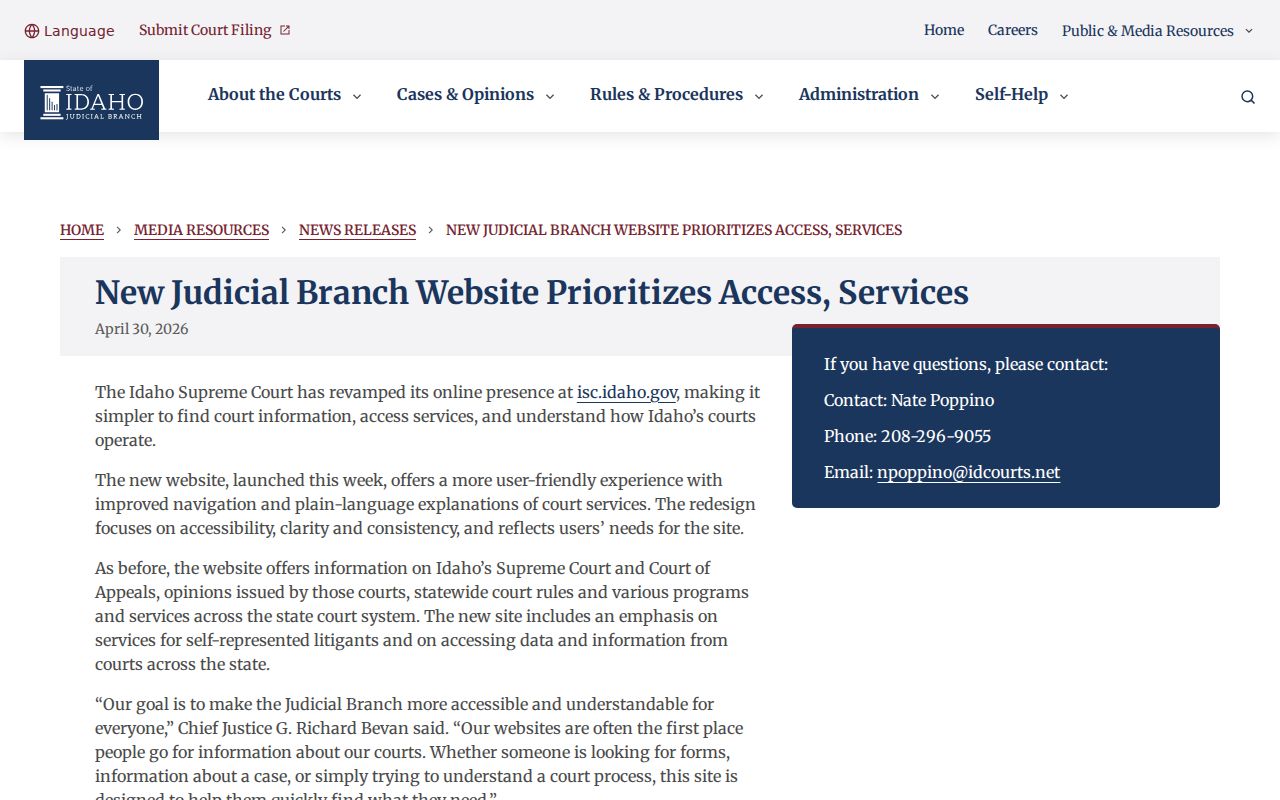
Current court and county sources should control both the search route and status determination.
Idaho Warrant Search Fields
Local Idaho systems differ, but the useful controls and result fields are consistent enough to plan a search. County scope must remain clear. A matching name alone is not reliable identification.
| Field Label | Type | Required | Notes |
|---|---|---|---|
| Last Name / First Name | Text | One often required | Try spelling variants and confirm identity elsewhere. |
| Warrant Number | Text | No | Agency-issued identifier. |
| Case Number | Text | No | Cross-check the related iCourt case. |
| Issue Date / Range | Date | No | Helps separate older and newer events. |
| Court / County | Result | Displayed | Identifies the District Court or Magistrate Division. |
| Status | Result | Displayed | May show active, served, recalled, or quashed. |
Some sheriff lists display a date of birth or physical details. Treat those details with care and verify them against the warrant number, case, and issuing county.
What Idaho Warrant Records Show
A public entry may combine court and sheriff data. It can identify the alleged basis and current processing status, but it does not establish guilt. Bond and service information can change after an online list was posted.
| Field | What It Shows |
|---|---|
| Identity | Name and limited identifying detail where lawfully displayed. |
| Warrant and case numbers | Identifiers used by the agency and Idaho court. |
| Issue date | Date the judicial authority was entered. |
| Charge or reason | Alleged offense, failure to appear, or compliance basis. |
| Level | Felony, misdemeanor, infraction-related, or other classification. |
| Bond | Amount, type, or no-bond indicator when public and current. |
| Issuing office | County, court, judge, or serving agency. |
| Status | Service, return, cancellation, recall, or quash information. |
The statewide court news feed also warns the public about fraud. An official Idaho court news source reported fake court texts that demanded money.
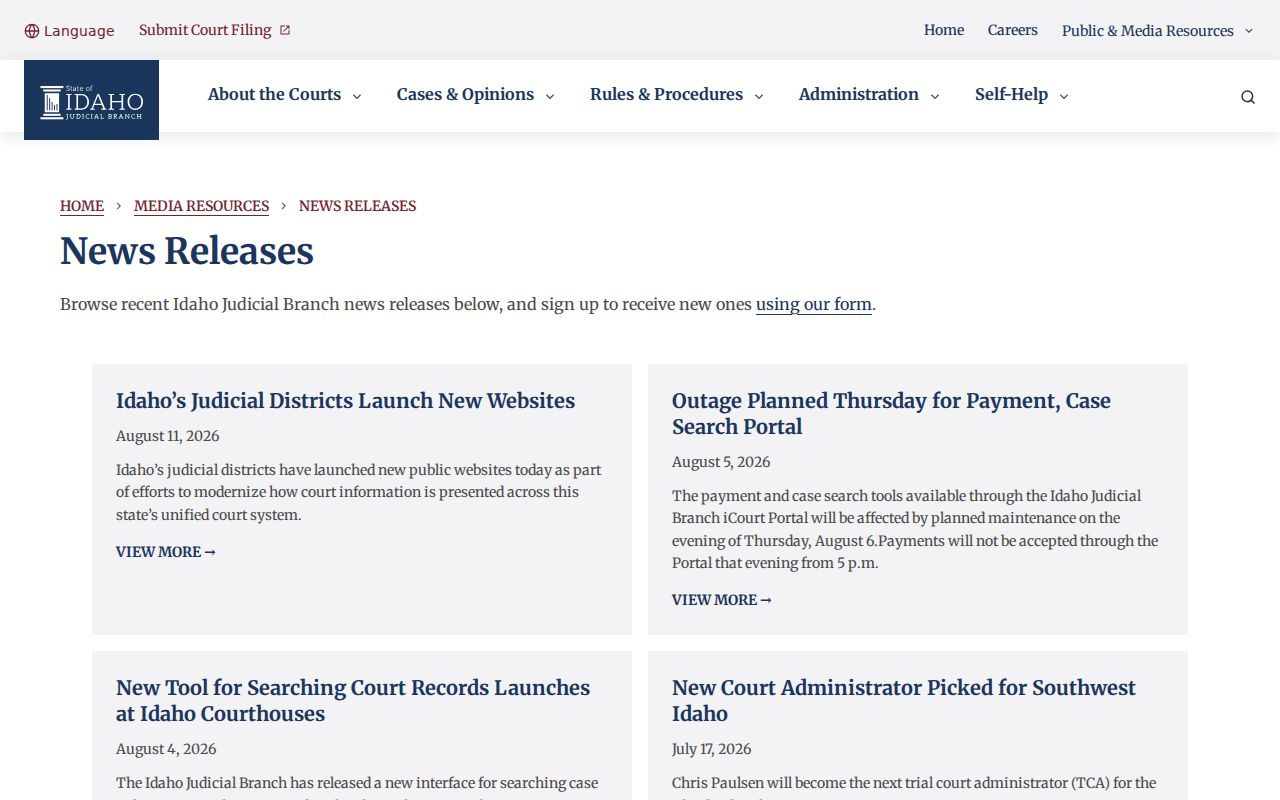
A payment demand sent by text is not proof of an Idaho warrant. Verify the case with the clerk or sheriff through an official government contact.
Find Idaho Warrants by County
Idaho has 44 county filing contexts within one unified judiciary. The county where the case arose remains the key to warrant custody, confirmation, bond, and return. One county may offer an online list, another may require a call, and another may publish only selected wanted persons. None of those formats becomes statewide merely because it is online.
Use the full Idaho county directory to identify the official sheriff and Clerk of the District Court. Check every county reasonably tied to the person or case. If the alleged warrant concerns felony probation or parole, IDOC Fugitive Recovery may be the proper channel. An ISP, IDOC, or local most-wanted notice is not a complete list of active warrants.
Idaho's Judicial Branch is led by the Supreme Court, while warrant authority in a trial matter remains tied to the issuing District Court or Magistrate Division. An official judicial announcement supplies statewide court context rather than a warrant lookup.
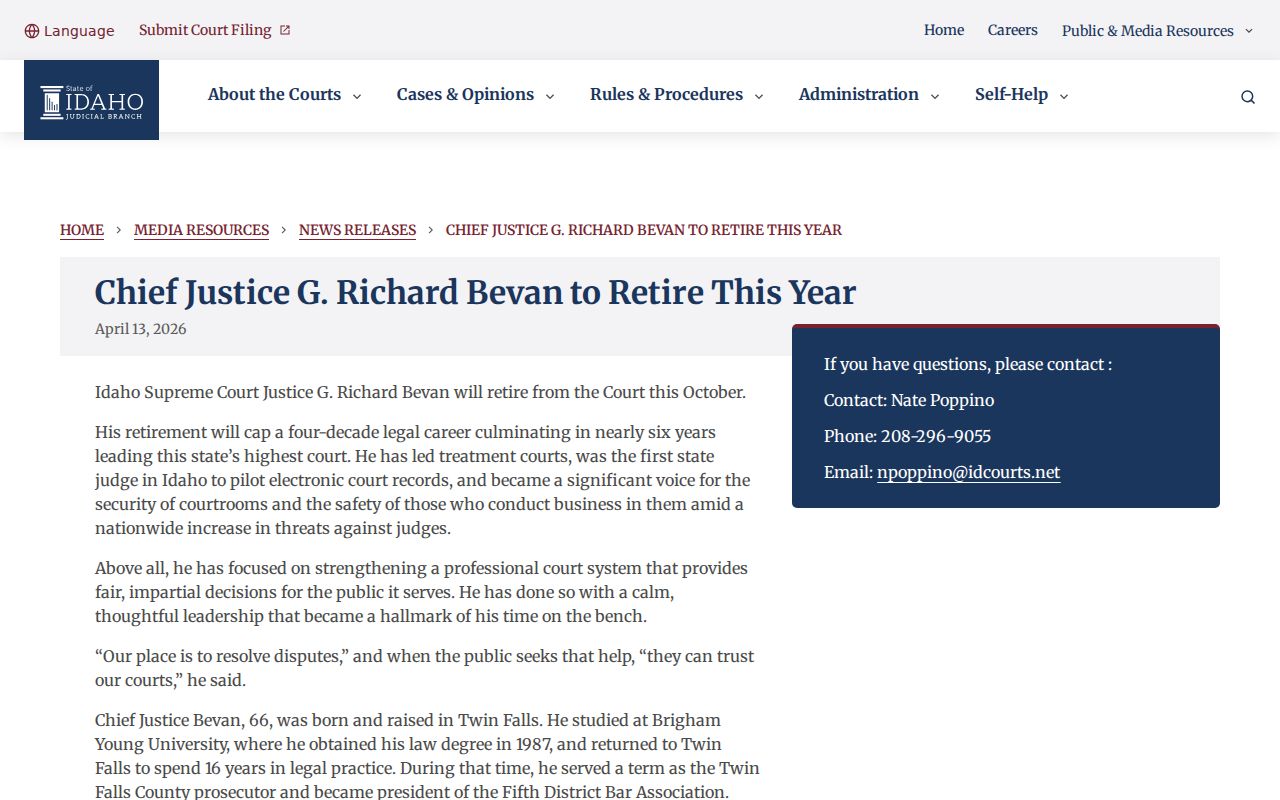
Statewide court information explains the system, but only the issuing court and responsible agency can confirm a live warrant.
Resolve an Idaho Warrant
Identify the exact Idaho court, case number, reason, and bond terms before acting. A licensed Idaho criminal-defense attorney can make a controlled inquiry, seek a hearing, ask for recall or quash, arrange surrender when needed, and address bond. The available path depends on the order. It may require a court appearance, motion, authorized cash or surety bond, or compliance with a new hearing date. Paying an old traffic balance does not cancel every warrant until the judge recalls it and agency systems update.
After action is taken, obtain docket or written confirmation. Allow time for court and law-enforcement systems to update, but do not treat a screenshot as official proof. If arrest seems imminent or safety is at risk, use counsel and the issuing agency rather than an anonymous search service.
Important: Consult an Idaho lawyer before appearing in person because asking at a warrant desk may expose the subject to immediate arrest.
Idaho Tips and Wanted Notices
Local sheriffs and regional tip programs may publish selected fugitives or accept anonymous information. Research did not establish one permanent statewide Idaho Crime Stoppers warrant portal, so a local announcement should be read within its stated jurisdiction. The same limit applies to warrant roundups and amnesty events. They are episodic and must be confirmed through a current official notice.
A wanted-person post may omit many active warrants. Conversely, an old post can remain visible after a court event. Report urgent location or safety information to the agency named in the current notice. Use the ordinary county and court process to check personal warrant status.
Restricted Idaho Warrant Records
Idaho Court Administrative Rule 32 governs public access to judicial records. Unreturned search warrants and their supporting affidavits or testimony are restricted. Sealed juvenile matters, protected investigations, confidential informant material, and shielded cases also may not appear. A public case number does not override those protections.
Federal warrants are not Idaho county court records. They involve federal courts and law-enforcement systems. IDOC agent warrants for people under felony supervision can also follow correctional procedures rather than the county roster model. These gaps explain why a clean iCourt search or sheriff list is not a guarantee.
Redaction hides protected details while leaving other content open. Sealing restricts access by court order. Exempt material is closed under a rule or law without a separate sealing order. Idaho shielding can remove qualifying criminal-case records from public view while preserving access for the defendant and authorized justice users. Each status affects what a public warrant search can return.
Note: Idaho warrant information is time-sensitive, so confirm service, recall, quash, and bond status with the issuing office before relying on it.