
Idaho Arrest Records and Charges
Idaho arrest records originate with the arresting police department or sheriff. Booking can create a name, booking number and time, arresting agency, intake details, initial alleged offenses, and bail status. An arrest is not a judicial finding. The officer sends reports and evidence to the county prosecuting attorney, or an appropriate city prosecutor for some misdemeanor or ordinance matters. The prosecutor decides whether to file a complaint or other charging instrument. Release without a filed case is possible.
The court charge record begins when the prosecutor’s allegation is accepted for filing with the county’s Clerk of the District Court. It can show exact count text, Idaho Code or ordinance section, offense date, felony or misdemeanor or infraction designation, amendment history, plea, and disposition. Booking and current custody details belong with the jail or arresting agency, while the full prosecution appears in Idaho criminal court records. Court charges after arrest must be read count by count.
Search Idaho Arrest Records
Use separate channels for separate questions. A county jail roster answers whether a person is currently booked and what allegations or bail are listed at that moment. The official iCourt Portal answers what charges were filed and how each count progressed. A county prosecutor or sheriff records request may reach releasable referral, declination, or booking material. The Idaho State Police BCI repository compiles reported Idaho arrests and dispositions but does not supply the underlying court-document set.
- Identify the county, arresting agency, approximate date, and subject’s full name before searching.
- Check the county jail or sheriff for current booking information and a booking sheet request route.
- Search iCourt by defendant name or exact case number, then narrow by county, criminal case type, and date.
- Open the case and record each count’s statute, level, amendment history, current status, and final disposition.
- Use the Idaho county directory for certified court documents or local sheriff and prosecutor records.
A representative official county route is the Ada County Sheriff records-request service, which illustrates the local scope and the referral to BCI for statewide history.
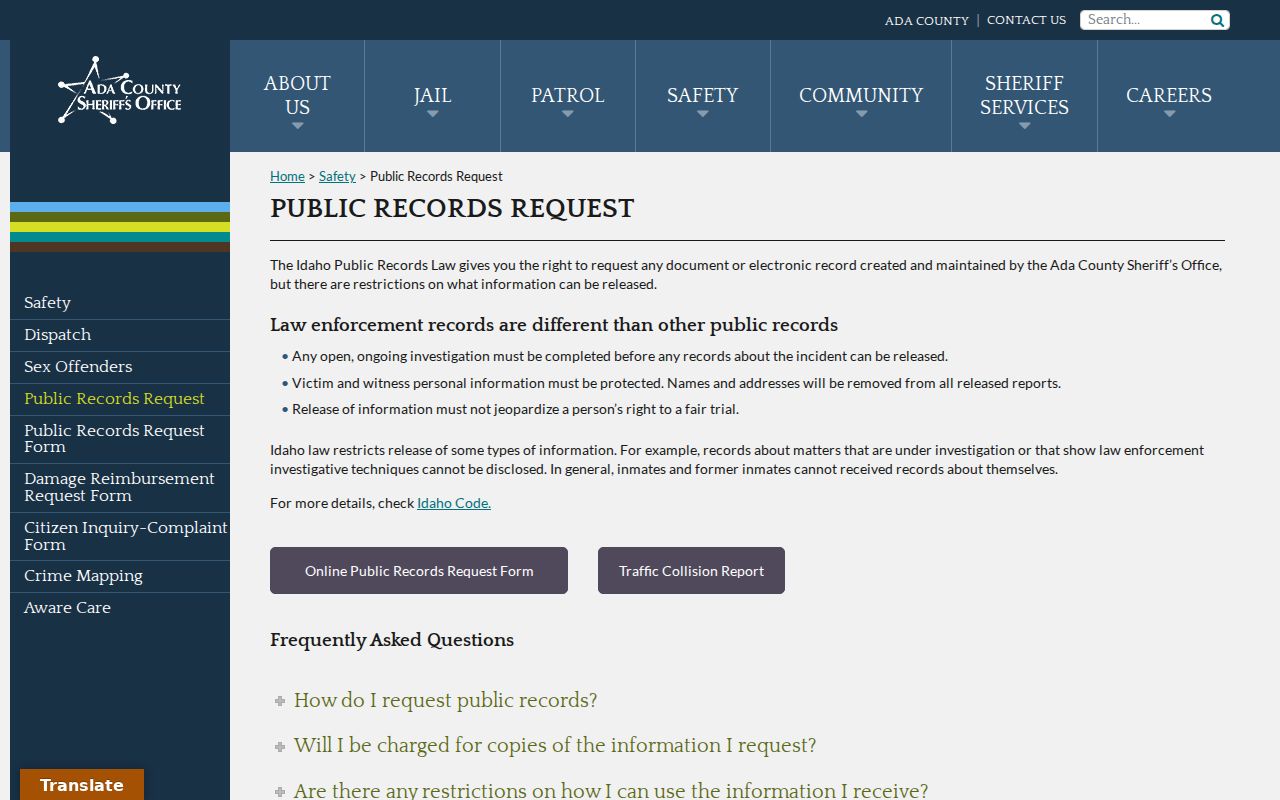
The example should not be treated as a statewide arrest database. Each Idaho sheriff controls its own booking and agency records, and local request methods can differ.
Idaho Charges After Arrest
Idaho uses several charging instruments. A criminal complaint is a sworn written allegation that commonly starts proceedings in the Magistrate Division. A misdemeanor can remain there. For a felony, a magistrate conducts or receives a waiver of the preliminary hearing. If the matter is bound over, the prosecutor files an information in District Court. A grand jury indictment can initiate or supersede charges without the conventional preliminary-hearing route. A citation can also create a Magistrate Division case for infractions and many misdemeanor or traffic matters.
| Complaint | Information | Indictment | |
|---|---|---|---|
| Source | Sworn allegation filed to begin court proceedings | Prosecutor-signed formal accusation | Grand jury charging determination |
| Idaho Use | Common in Magistrate Division and early felony stages | District Court felony prosecution, often after bind-over | Initiates or supersedes indicted counts |
| What It Proves | An accusation, not guilt | An accusation, not guilt | Probable-cause charging action, not a verdict |
Idaho Court Charge Status
Status labels describe a point in the process. Referred or requested means police sent an allegation to a prosecutor, but no filing is assured. Filed or pending means the charging instrument is accepted and unresolved. Amended means the count, statute, or level changed. Bound over means the felony moved from its magistrate preliminary stage to District Court; it does not mean conviction. Dismissed ends the count in that case, subject to the order and any refiling context. Acquitted means the factfinder did not convict.
- Declined or refused
- A prosecutor did not file the referral; this may exist only in prosecutor or agency data.
- Guilty or convicted
- A plea or verdict led to a judgment, whose exact terms control.
- Withheld judgment
- An Idaho-specific disposition that must be understood from the signed order, not a shorthand label.
Idaho Charges vs. Convictions
Neither an arrest nor a filed charge is a finding of guilt. A jail roster’s listed offense can change after prosecutor review. An iCourt case can retain the history of an original count after an amendment, and several counts in one case can have different results. Read the final judgment and disposition for each count. When the outcome matters for licensing, housing, immigration, firearms, or another serious purpose, obtain a certified disposition from the clerk rather than relying on a screen summary.
| Charge | Conviction | |
|---|---|---|
| Stage | Accusation | Verdict or plea |
| Burden of Proof | Probable cause | Beyond reasonable doubt |
| Meaning | Alleged conduct under a cited law | Judicial result after a plea or trial |
Idaho Sealing and Expungement
Idaho treats court sealing, criminal-case shielding, redaction, and repository expungement as separate forms of relief. A qualifying shielding order under Idaho Code §67-3004(11) removes the court record from public view while retaining access for the defendant and official justice users. A BCI correction or expungement follows the repository’s own process. Eligibility is fact-specific and can depend on the arrest outcome, charge, time, compliance, and prior history. Relief is sought from the county court or agency that controls the record.
| Sealed | Expunged | |
|---|---|---|
| Primary Effect | Restricts public access to a court record | Changes an eligible agency repository entry under specific law |
| Official Access | Can remain available to authorized justice users | Depends on the statute and repository involved |
| Next Step | File in the court and county controlling the case | Use BCI or the correct custodian’s procedure with supporting dispositions |
Idaho Charge Codes and Levels
For every count, capture the exact Idaho Code or ordinance section, offense text, offense date, and felony, misdemeanor, or infraction designation. Idaho does not use one universal Class A, B, or C misdemeanor scheme. Penalties follow the specific offense and applicable general law, so a search result should not be translated into an invented class or degree. Magistrates retain misdemeanors and infractions and conduct felony preliminary proceedings. District judges handle felony trials after bind-over or indictment.
One arrest can lead to several counts with different levels and outcomes. It can also lead to no filed case. A booking allegation and a prosecutor’s formal count should never be treated as interchangeable. Use the county, case number, offense date, and lawful identifying details to avoid confusing people who share a name.
Idaho Statewide Criminal History
The Idaho State Police Bureau of Criminal Identification maintains the central repository. It is based on arrest information reported by Idaho justice agencies and associated charge and disposition reporting. The check is Idaho-only, not an FBI or multistate history. If an arrest fingerprint card was never submitted, the event may be missing. A name-based request can also miss an alias or false birth date, while fingerprints support a more reliable identity match.
The official name-based request costs $20 per subject and asks for names, aliases, birth date, sex, race, address, requester information, and payment. A current subject waiver affects what older unresolved arrest information may be released to a noncriminal-justice requester. BCI does not telephone or fax results and states no fixed turnaround. For a complete challenge, use the fingerprint-based route and supply certified county dispositions when correcting the repository.
Federal and Consumer Checks
Federal prosecutions do not appear in Idaho iCourt merely because the conduct occurred in Idaho. The U.S. Attorney’s Office for the District of Idaho represents the federal government in those matters.
Federal court charges belong in the federal court system, while Idaho prosecutor filings belong in iCourt and the county clerk’s file. BCI also warns that an Idaho check is not a national FBI history.
A formal consumer report used for employment, housing, credit, or another regulated decision must follow the Fair Credit Reporting Act. A casual public-record lookup is not a substitute for a compliant report, identity verification, and source-document review. iCourt supplies case status; BCI supplies a compiled Idaho history; the county clerk supplies the certified court record.
Important: Idaho Court Records is not a consumer reporting agency, and its information may not be used for employment, credit, housing, or other FCRA decisions.
Restricted Idaho Charge Records
Juvenile, child-protection, sealed, shielded, and court-exempt records may not appear in public iCourt results. Personal identifiers and protected victim or minor information are redacted. Unreturned warrants, certain warrant support before return, confidential informant material, ongoing investigative details, prosecutor work product, and information that could threaten a fair trial can also be withheld. A public case number does not override those limits.
Call the county jail for present custody, the sheriff custodian for a booking sheet, the Clerk of the District Court for the complaint, information, judgment, or certified disposition, and BCI for a statewide Idaho history. The statewide search index does not centralize custody of those distinct records.