
Search Idaho Court Records
The official Idaho iCourt Portal covers trial cases in all 44 counties. Smart Search accepts a case number or a person or business name. Advanced controls can narrow a query by court location, case type, party role, filing date, and status. Search Hearings uses a court location and date range to locate scheduled proceedings. The portal also offers payment access for eligible criminal and traffic matters. JavaScript and cookies are required, and a recurring CAPTCHA may interrupt a session.
Prepare the full party name, former names, likely filing county, approximate year, and case type before searching. An exact case number is best. Preserve every hyphen in an Idaho number such as CR01-24-31665 because the prefix, location code, year, and sequence help identify the right file. A portal entry is an index, not proof that the underlying PDF is available. The filing county’s Clerk of the District Court remains the source for certified judgments and full documents.
- Open Smart Search in the official iCourt Portal. Use the exact case number when known; otherwise enter the party or business name.
- Apply the location, case type, party type, date, and status filters shown in the current portal session.
- Open a result and compare its caption, county, filing date, and party role before relying on it.
- Read the case summary, register of actions, hearings, disposition, and public financial information.
- For a pleading, certified order, exhibit, audio file, or archived case, request it from the clerk in the filing county.
Idaho also provides electronic services for filing rather than research. The Idaho File & Serve system is shown in the official service view below.
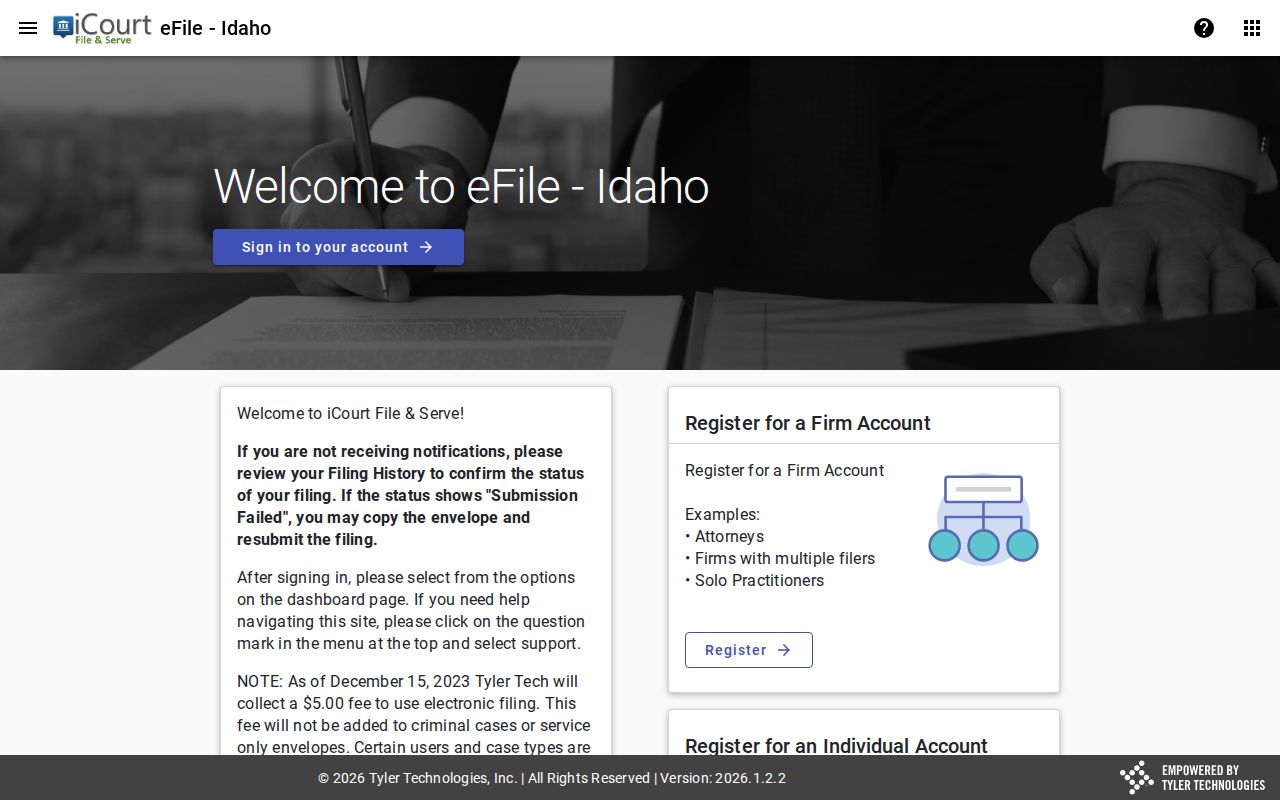
File & Serve lets authorized users submit case material, but filing a document electronically does not make a confidential document public.
Idaho Court Records Search Fields
The iCourt interface can change by session, but its public Smart Search uses a stable core of query and filter controls. County courthouse kiosks may reveal records that anonymous internet access does not. The fields below describe the official statewide form, not a promise that every option appears for every case category.
| Field Label | Type | Required | Notes / Format |
|---|---|---|---|
| Search Criteria | Text | Yes | Enter a case number or party or business name; an exact case number is most reliable. |
| Location | Multiselect | No | Choose the Idaho court or filing county when known. |
| Case Type | Multiselect | No | Values depend on location and may include civil, criminal, family, probate, and juvenile categories. |
| Party Type | Dropdown | No | Available roles depend on the selected case category. |
| File Date | Date range | No | Use from and through dates to limit common-name results. |
| Case Status | Dropdown | No | Filters active and disposed matters using the current session labels. |
| CAPTCHA | Challenge | When shown | The portal may require a new challenge about every five minutes. |
Types of Idaho Court Records
Idaho District Courts have general jurisdiction. District judges hear felony trials, civil claims over $10,000, administrative review, and appeals from magistrates. The Magistrate Division is part of the same District Court and handles misdemeanors, infractions, traffic, felony preliminary stages, family cases, probate, guardianships, evictions, and civil claims through $10,000. Idaho has no separate municipal or justice-of-the-peace court network to search. The elected county clerk serves ex officio as Clerk of the District Court for both levels.
Case type affects both what appears and what may be inspected. Civil and small-claims files commonly include pleadings, service, motions, orders, judgments, and satisfaction entries. Criminal files add charges, pleas, bond, verdict, disposition, and sentence. Family and probate files may contain public orders beside protected reports or identifiers. Traffic records show citations and court outcomes, while the state driver record is a different agency file.
- Civil: complaints, answers, service, motions, orders, judgments, enforcement, and appeals.
- Criminal: complaints, information or indictment, pleas, hearings, verdicts, judgments, sentences, and later review.
- Family and protection: petitions, parenting plans, support worksheets, orders, decrees, modifications, and protected-address controls.
- Probate and guardianship: petitions, wills when filed, appointments, notices, inventories, accountings, and orders, subject to role limits.
- Traffic and infractions: citation details, alleged code section, plea, hearing, disposition, payment, and failure-to-appear action.
- Juvenile, adoption, and commitment: court-controlled files with much tighter public-access restrictions.
What Idaho Court Records Show
An Idaho case result joins header information to parties, events, hearings, outcomes, and public financial data. The chronological register may list a complaint, summons, return, response, motion, notice, minute entry, order, judgment, sentence, or appeal notice. A listed event does not guarantee a public download. Attorneys of record and approved extended users have different access, while anonymous users must often obtain documents through a courthouse kiosk or clerk request.
| Field | What It Shows |
|---|---|
| Case Number | Case prefix, county or location identifier, filing year, and sequence in the Odyssey format. |
| Case Header | Caption, filing location, case type, filed date, status, and assigned judicial officer where public. |
| Parties | Plaintiff, defendant, petitioner, respondent, State of Idaho, counsel, and representation role as applicable. |
| Register of Actions | Dated filings, notices, minutes, hearings, orders, judgments, and appeal events in sequence. |
| Charges | Count, offense text, Idaho Code section, level, plea, disposition, and sentence where public. |
| Hearings | Date, time, place, hearing type, judge, and current status. |
| Financial Record | Assessments, fines, costs, restitution, payments, and balance where the portal exposes them. |
Idaho Court Records Access Rules
Idaho Court Administrative Rule 32 is the main access framework for judicial case records. It presumes access to open proceedings and many indexes, calendars, filings, minutes, orders, opinions, judgments, transcripts, and admitted evidence after the proper stage. Idaho Code Title 74 governs many executive and local agency records, but judicial records follow the Supreme Court’s specific rule when the systems differ. A court custodian may require a clear written description of the requested material.
For most judicial requests, a custodian has three working days to disclose, deny, or refer the matter to a custodian judge. When more time is needed, notice is sent and the outside response period is ten working days. Copy charges may require prepayment, and the local clerk determines paper-copy cost within the statutory maximum. Inspection, plain paper copies, certified copies, exemplified copies, recordings, and transcripts are distinct products. Ask the filing clerk for a quote and the correct proof of identity when role-based access is sought.
The Idaho Attorney General’s public-records resources show the separate Title 74 process used for nonjudicial government records.
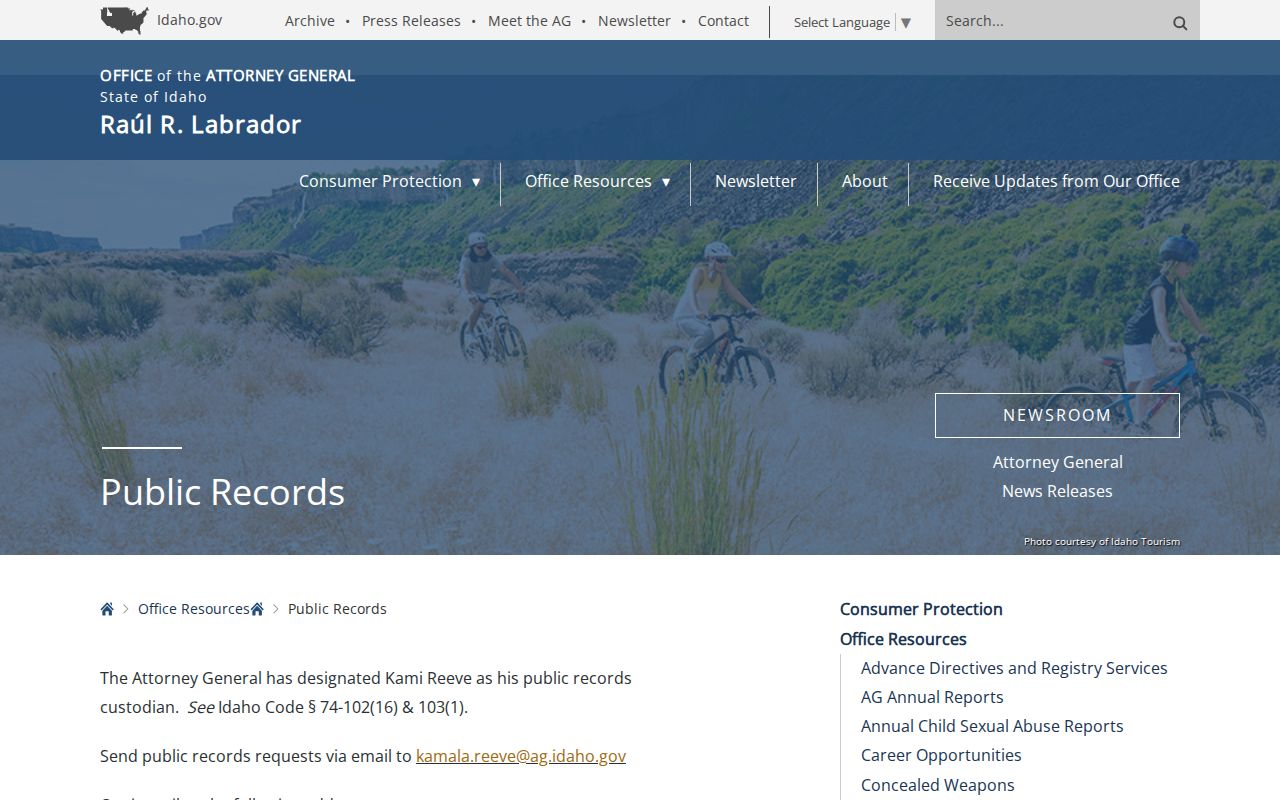
This distinction matters because a request for a court pleading goes to the county clerk, while a request for sheriff or agency material goes to that agency’s records custodian.
Note: Public access to an Idaho case index does not create a right to every document, exhibit, identifier, or protected report.
Restricted Idaho Court Records
ICAR 32 and specific laws restrict juvenile corrections, child protection, adoption, mental-health treatment, protected addresses, unredacted reference lists, Social Security numbers, full account numbers, and other sensitive identifiers. Criminal restrictions include unreturned warrants, certain supporting affidavits before return, pretrial risk assessments, presentence investigation reports, confidential-source material, and sealed or shielded cases. Exhibits can also receive special treatment. Before final trial disposition, permission from the custodian judge and supervised viewing may be required.
Idaho uses distinct terms. Redaction hides protected facts while leaving the rest of a filing open. Sealing restricts a record by court order. Exempt material is closed by law or rule without a separate sealing order. Criminal-case shielding under Idaho Code §67-3004(11) removes a qualifying court record from public disclosure while preserving official access. Relief is case-specific and is requested in the court and county that controls the file; a portal change does not automatically alter records retained by every other agency.
The Judicial Branch posts current and pending court-rule amendments, including changes affecting record access.
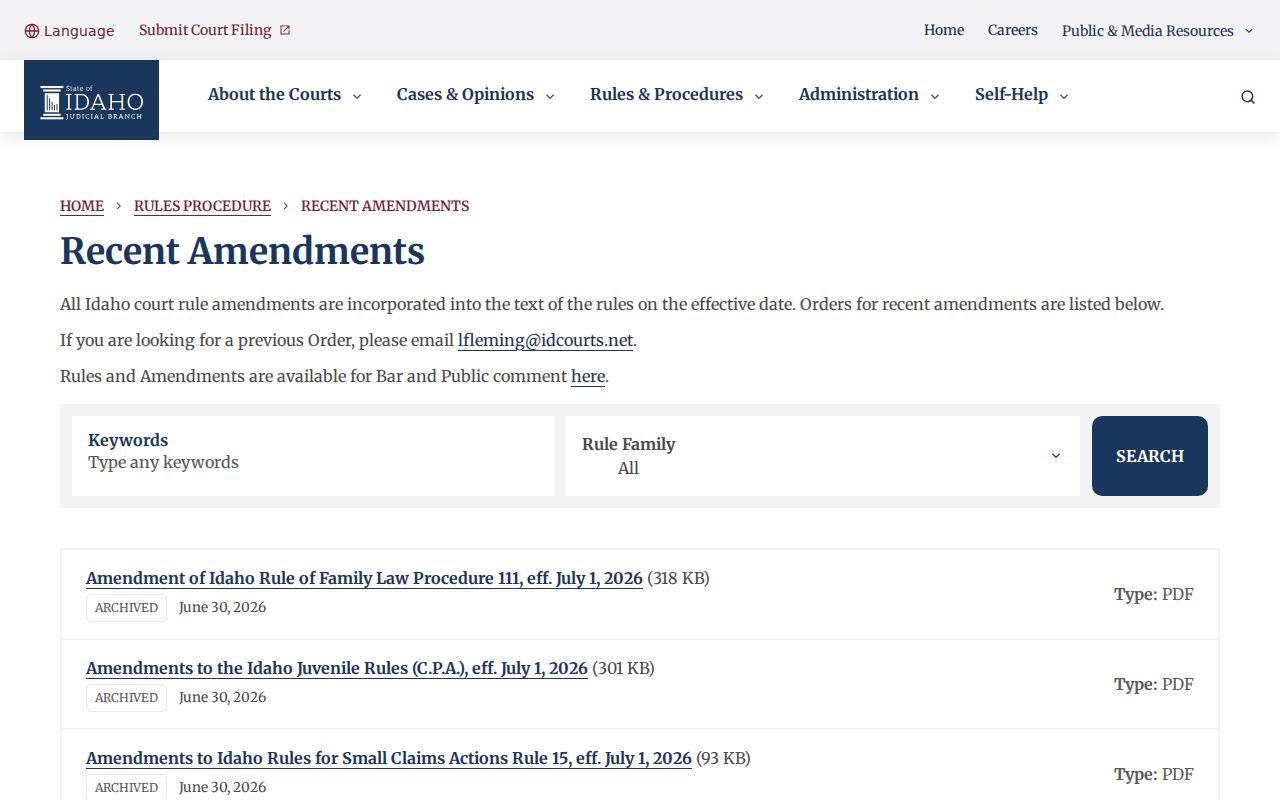
Checking the current rule text is essential when access depends on a recent amendment, sealing order, or role-based exception.
Request Idaho Court Records
Every Idaho county has one elected county clerk who serves ex officio as Clerk of the District Court. That unified office maintains District Court and Magistrate Division files, even when separate counters handle civil, criminal, family, probate, or traffic work. A request should give the county, court division, exact case number, caption, approximate year, document titles and dates, requested copy type, delivery method, and a cost ceiling. Older paper or microfilm files may require archive retrieval.
Use the Idaho county directory to reach the filing county. A courthouse kiosk can provide available case information, while an in-person counter, mail request, or locally accepted email or fax can be used for copies. Do not send a trial-case request to the Idaho Supreme Court. Appellate records use the Supreme Court’s designated route after the record is lodged there.
People preparing their own filings can consult Idaho’s official Guide & File service.
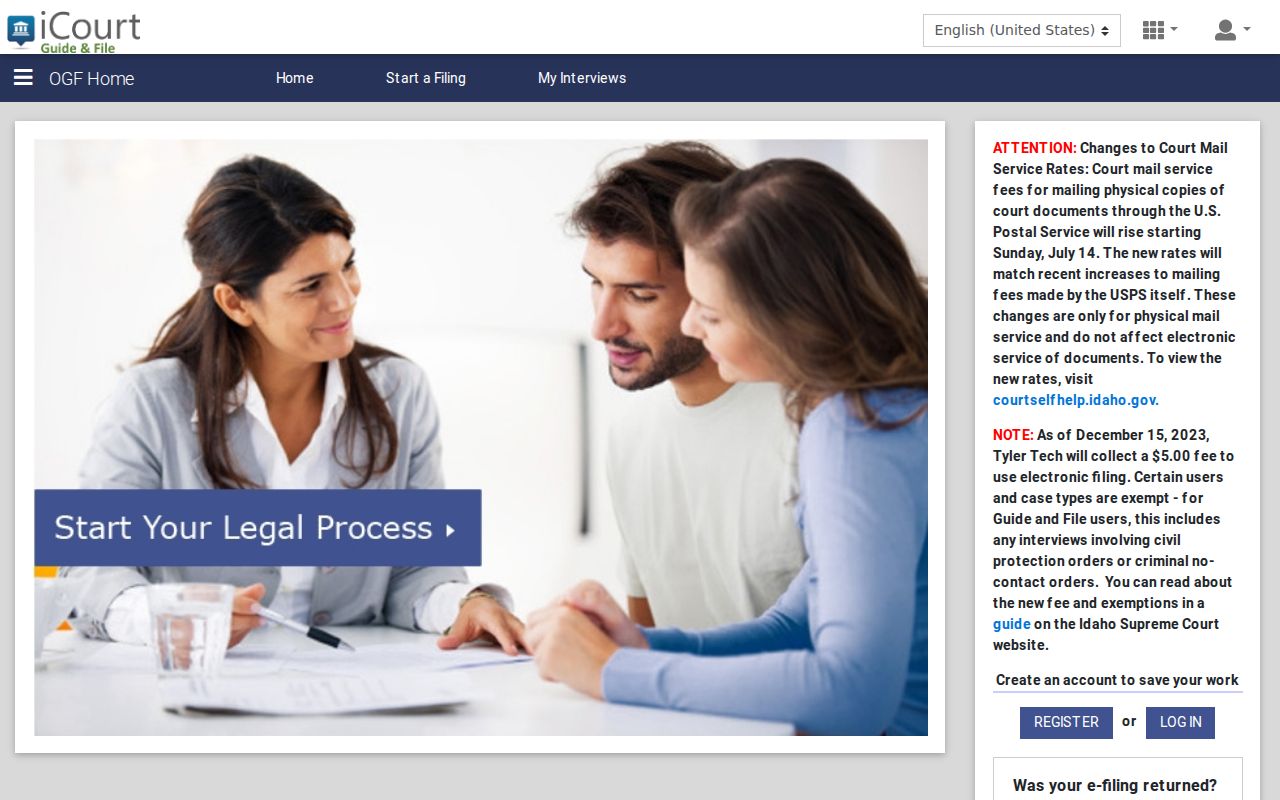
Guide & File supports selected filings, but county clerks provide procedural access and cannot advise whether a legal claim will succeed.
The Judicial Branch also publishes civil and fee-waiver forms for service, subpoenas, and other court tasks.
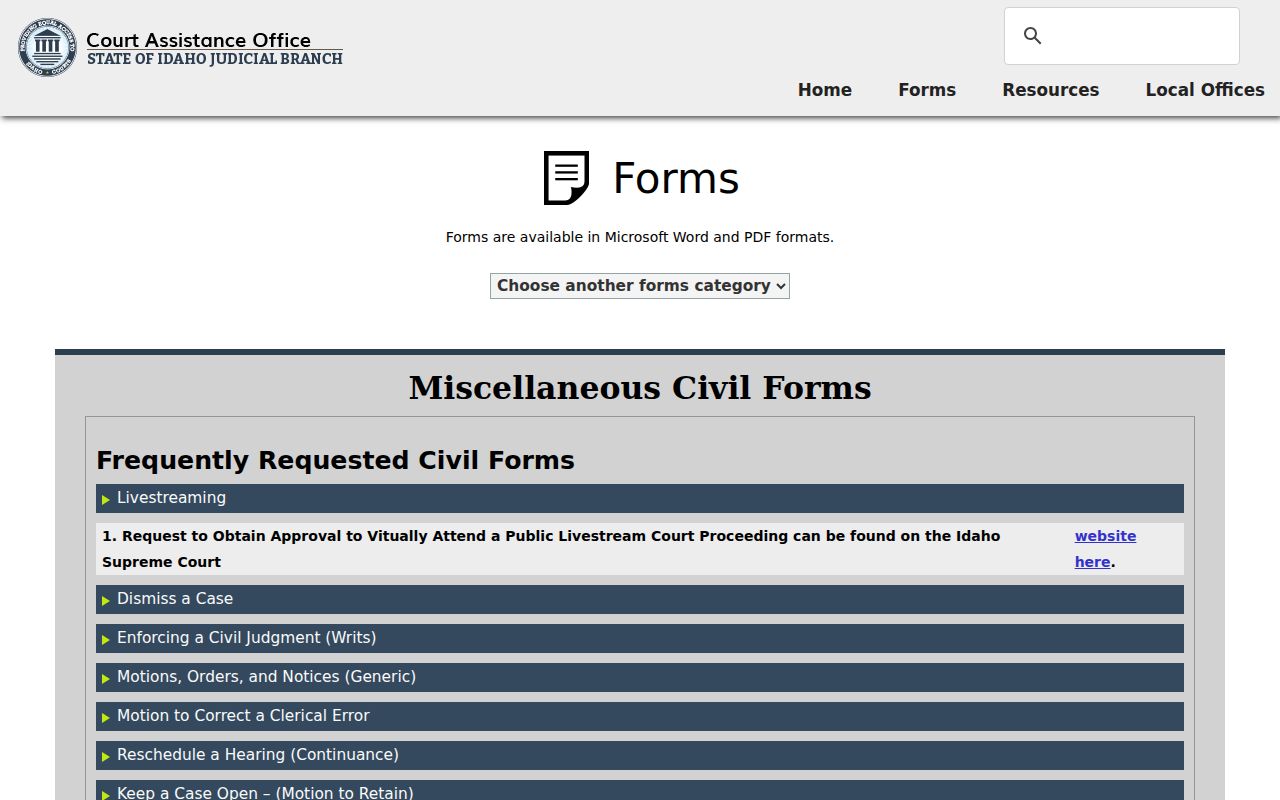
Statewide forms improve consistency, yet the completed filing and source record still belong with the correct Idaho county clerk.
Tip: Copy the county and case number from iCourt before contacting the clerk; both details reduce delays and same-name errors.