
Idaho Court System Overview
Idaho has five functional levels within one state structure: the Supreme Court, the Court of Appeals, District Courts, the Magistrate Division, and the Small Claims Department. The Supreme Court is the court of last resort and the administrative head of the branch. The Court of Appeals is one statewide intermediate court. District Courts exercise general trial jurisdiction across seven judicial districts. Each county also has a Magistrate Division, and small claims is a simplified department within that division. Idaho does not add a separate criminal high court, probate court, municipal court, justice court, or county court.
Appeals do not follow a simple mandatory district-to-appellate-to-supreme chain. A Magistrate Division appeal goes first to a District Court judge. An appeal from a District Court decision goes to the Idaho Supreme Court, which may retain the case or assign it to the Idaho Court of Appeals. A party may then seek Supreme Court review after a Court of Appeals decision. This assignment model explains why Idaho has a statewide Court of Appeals but no geographic appellate districts.
Appeals path: Magistrate Division › District Court appellate review › Idaho Supreme Court filing › possible assignment to Idaho Court of Appeals › possible Supreme Court review
| Court Level | Court Name | Jurisdiction / Case Types | Number in Idaho |
|---|---|---|---|
| Court of last resort | Idaho Supreme Court | Final state appeals, extraordinary writs, assigned or direct agency review, judicial administration | 1 court, 5 justices |
| Intermediate appellate | Idaho Court of Appeals | Supreme Court-assigned civil and criminal appellate review on the existing record | 1 statewide court, 4 judges |
| General trial | District Court | Felonies, civil claims over $10,000, agency review, and Magistrate Division appeals | 7 judicial districts across 44 counties |
| Limited trial division | Magistrate Division of District Court | Misdemeanors, traffic, preliminary hearings, family, juvenile, probate, evictions, and civil claims through $10,000 | Present in all 44 counties |
| Simplified department | Small Claims Department | Informal small civil matters using approved forms and small-claims rules | Within county Magistrate Divisions |
Idaho Supreme Court
The Idaho Supreme Court has five justices and is the final authority on Idaho law. It handles the state's ultimate civil and criminal appellate work, special writs, and direct review of certain Public Utilities Commission and Industrial Commission or worker-compensation orders. There is no separate Idaho criminal court of last resort. The Supreme Court also administers the unified judiciary, adopts court rules, and regulates lawyer admission and discipline. Its published holdings govern the lower state courts.
The official statewide judicial directory lists appellate, district, and magistrate judges.
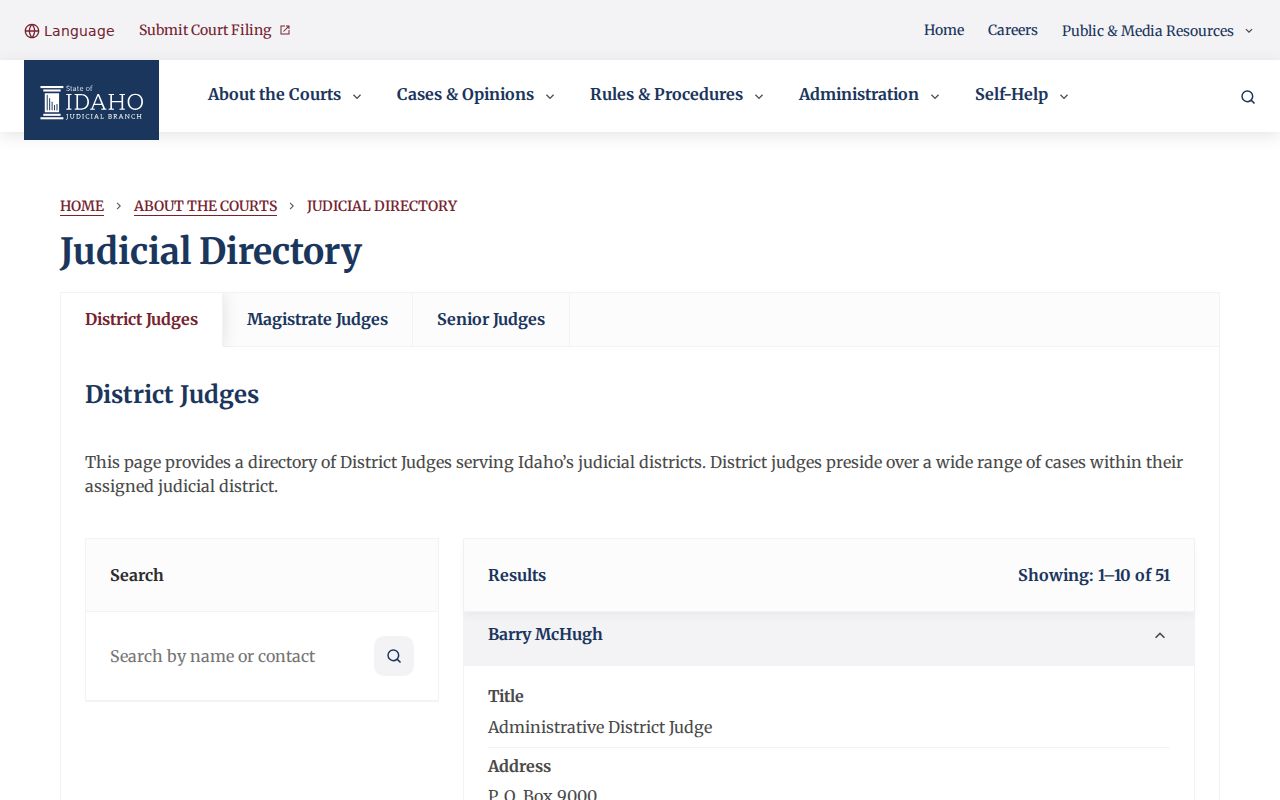
The directory is the current source for judicial assignments without freezing officeholder names into a permanent court-system description.
Idaho Court of Appeals
The Idaho Court of Appeals is one statewide intermediate court with four judges. Judges sit in panels of three and review an existing trial record for legal error. They do not retry witnesses or receive a new body of evidence. The Idaho Supreme Court assigns matters to the Court of Appeals, so there is no geographic appellate district tied to a county. The state's seven numbered judicial districts organize trial courts only.
An official announcement about the Court of Appeals chief-judge term also describes the four-judge court and its three-judge panels.
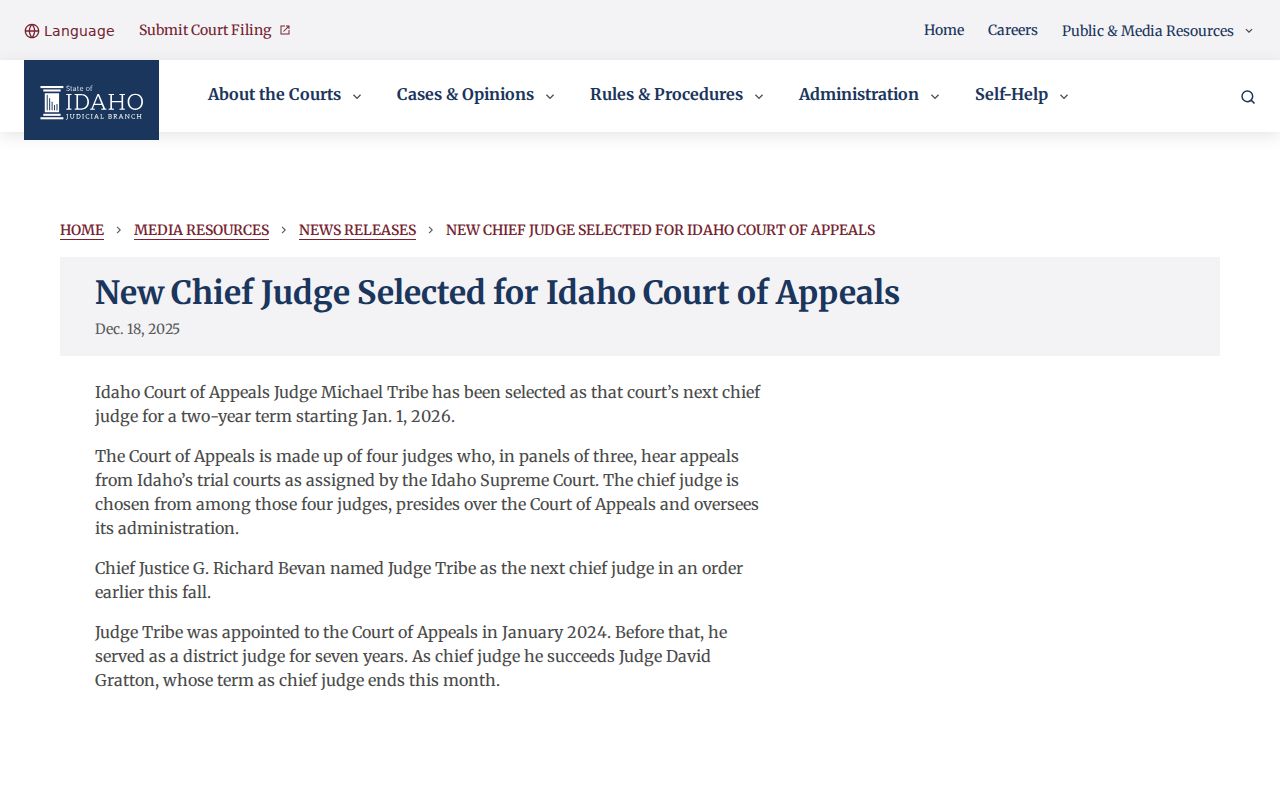
The statewide structure means every county follows the same assignment path instead of selecting a regional appellate court.
Idaho District Trial Courts
District Courts are Idaho's general-jurisdiction trial courts. District judges hear felony trials, civil claims over $10,000, administrative review, and appeals from Magistrate Division decisions. The 44 counties are grouped into seven judicial districts. Judges may travel among counties within a district, a practical feature in a large rural state. A judicial district is an administrative and service grouping, not an appellate district and not a separate county court.
The First District covers Benewah, Bonner, Boundary, Kootenai, and Shoshone. The Second covers Clearwater, Idaho, Latah, Lewis, and Nez Perce. The Third covers Adams, Canyon, Gem, Owyhee, Payette, and Washington. The Fourth covers Ada, Boise, Elmore, and Valley. The Fifth covers Blaine, Camas, Cassia, Gooding, Jerome, Lincoln, Minidoka, and Twin Falls. The Sixth covers Bannock, Bear Lake, Caribou, Franklin, Oneida, and Power. The Seventh covers Bingham, Bonneville, Butte, Clark, Custer, Fremont, Jefferson, Lemhi, Madison, and Teton.
Trial records stay with the clerk in the county of filing. Use the county directory to reach that local records source.
Idaho Court Jurisdiction Compared
Idaho assigns work between the District Court and its Magistrate Division by case type and, for civil disputes, the amount at issue. Small claims is not a separate court. It is a simplified Magistrate Division process governed by approved forms and its own rules.
| District Court | Magistrate Division | Small Claims Department | |
|---|---|---|---|
| Civil scope | Claims over $10,000 | Claims through $10,000 and evictions | Simplified small claims within the magistrate civil ceiling |
| Criminal scope | Felony trials | Misdemeanors, infractions, traffic, felony first appearances and preliminary hearings | None |
| Family and juvenile | Review role where assigned | Divorce, custody, support, juvenile matters | None |
| Probate | Part of unified District Court structure | Estate, guardianship, and conservatorship matters | None |
| First appeal | Idaho Supreme Court filing | District Court appellate division | District Court under small-claims rules |
How Idaho Court Cases Move
A civil action begins when a plaintiff files in the proper county and serves the defendant. The amount and subject determine whether District Court or the Magistrate Division handles the trial. A criminal action starts with a prosecutor's complaint or information, or with an indictment. A Magistrate judge conducts early felony proceedings before a felony moves to a District judge. The clerk assigns a case number and builds the register of actions in Idaho's statewide case system.
Criminal case flow: Complaint, information, or indictment › Magistrate first appearance and preliminary work › District Court arraignment › pretrial › plea or trial › sentence › Idaho Supreme Court filing › possible Court of Appeals assignment
Civil case flow: Complaint › service › answer › pretrial process › trial or ruling › judgment › Idaho Supreme Court filing › possible Court of Appeals assignment
Magistrate appeal flow: Magistrate ruling › District Court appellate review › further review under the applicable Idaho rules
The Idaho Rules for Electronic Filing and Service govern the electronic filing framework.
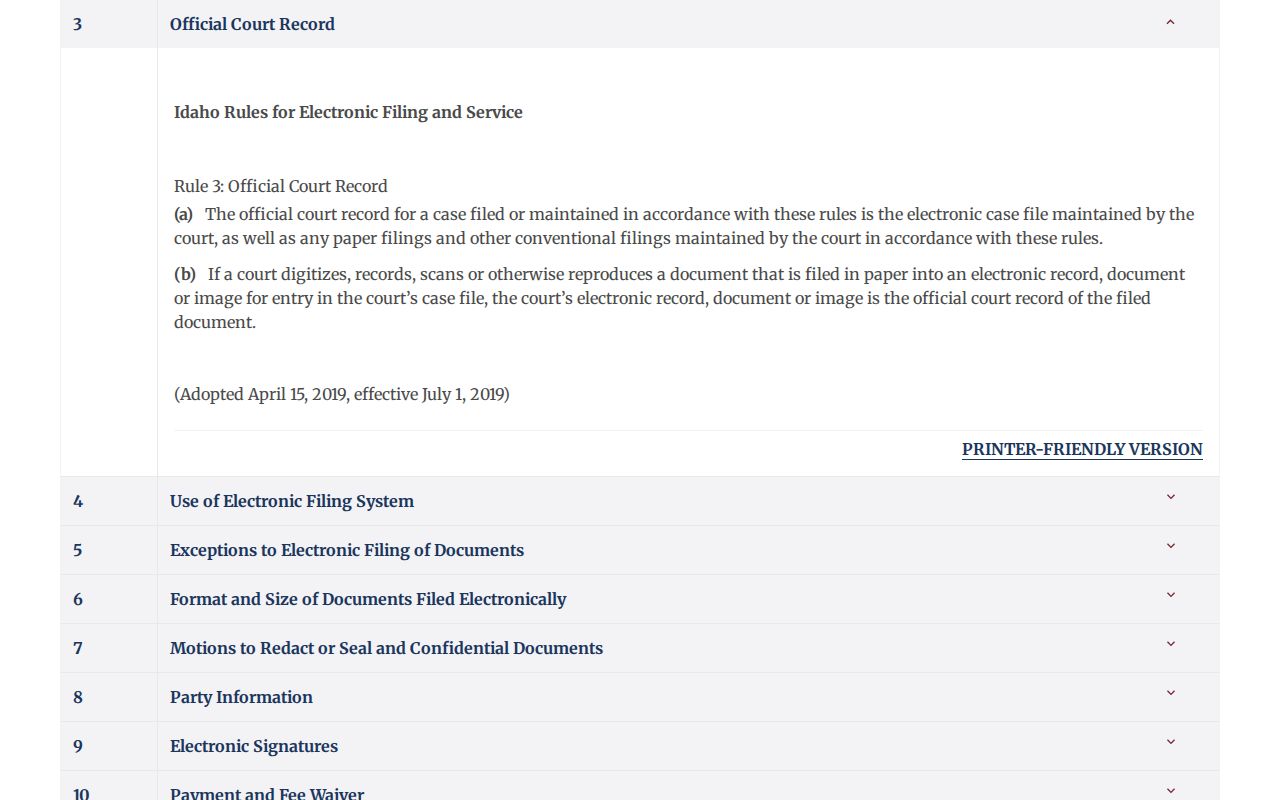
Electronic filing changes how a paper reaches the docket, but it does not alter which Idaho court has jurisdiction.
Idaho Court Divisions and Programs
Idaho county courts may use civil, criminal, family, juvenile, probate, or treatment assignments to manage work. These labels do not create new courts. Felonies and higher-value civil cases remain District Court matters. Misdemeanors, traffic, family, juvenile, probate, evictions, and civil claims through $10,000 are generally Magistrate Division work. The same elected clerk maintains both trial levels, though separate counters or staff units may handle the files. Access rules still vary by document, and juvenile or other protected material is not open merely because a public case event exists.
The Judicial Branch describes Idaho treatment courts for drug, mental-health, veterans, DUI, and other focused programs.
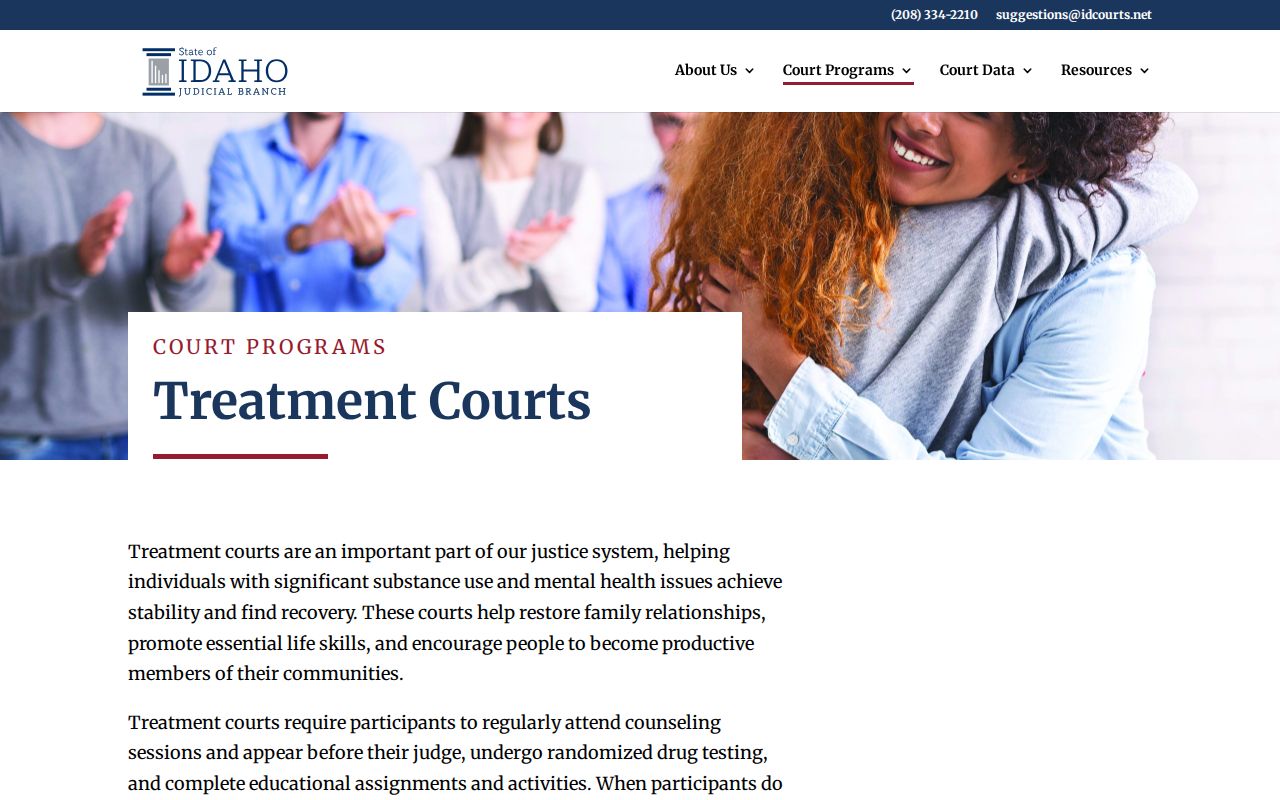
These programs are a state and county partnership governed by statewide rules rather than a separate tier in the Idaho hierarchy.
Idaho Magistrate and Small Claims
The Magistrate Division is part of District Court and is present in every Idaho county. Magistrate judges hear misdemeanors, infractions, traffic, felony first appearances and preliminary hearings, civil claims through $10,000, evictions, small claims, family matters, juvenile cases, probate, guardianships, and conservatorships. Small Claims is an informal department within that division. Idaho does not operate a parallel set of municipal or justice-of-the-peace courts, and probate is not assigned to an independent probate court.
Idaho also has a distinct water-law history. The official water adjudication resources cover the Snake River Basin Adjudication and related specialized work within the District Court structure.
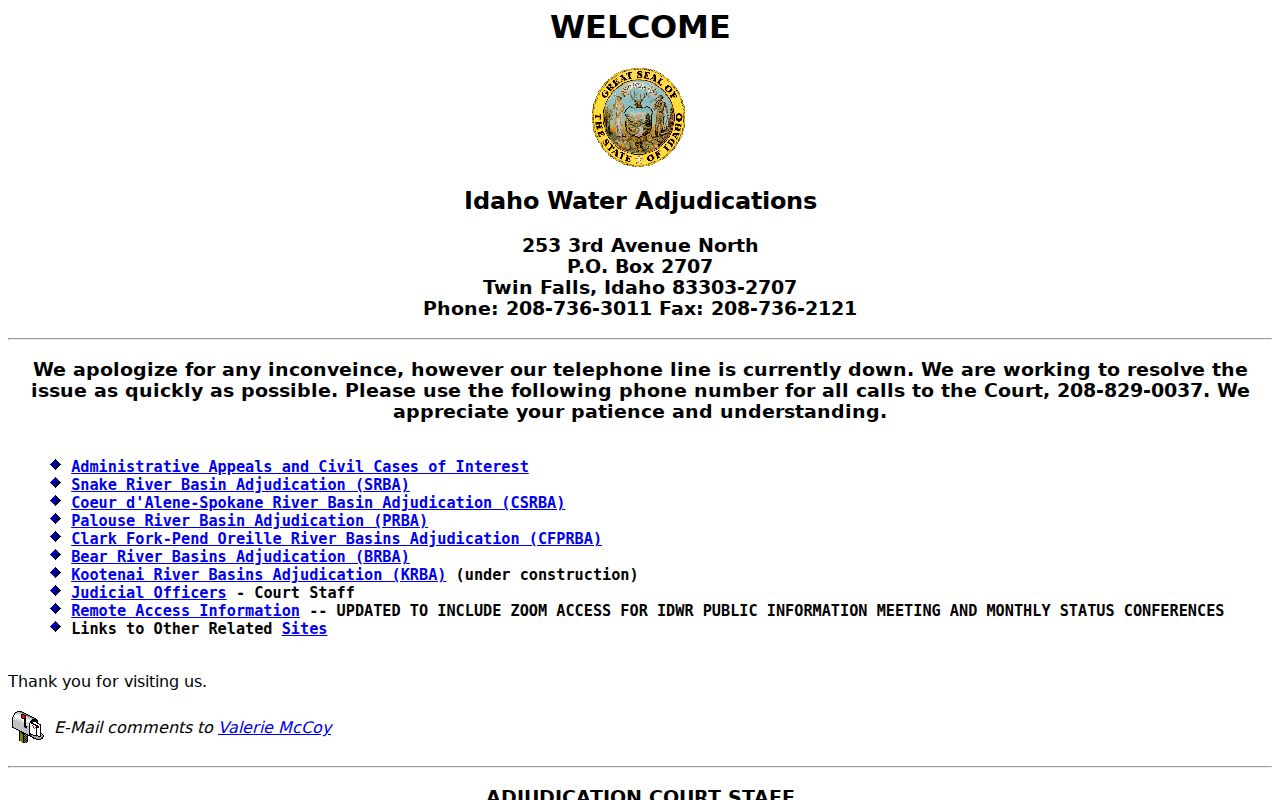
Specialized administration supports those complex cases without creating a court outside Idaho's unified hierarchy.
Federal Courts Serving Idaho
Federal cases use a separate judiciary. All Idaho counties lie in one United States District Court for the District of Idaho. The District of Idaho handles federal crimes, federal questions, qualifying diversity cases, civil-rights and constitutional claims, and federal-agency review. The United States Bankruptcy Court for the District of Idaho handles bankruptcy cases and adversary proceedings. Neither court is part of the Idaho District Court system, and bankruptcy must not be treated as state probate.
Federal appeals go to the United States Court of Appeals for the Ninth Circuit. Federal dockets and documents are generally searched through PACER, while public terminals offer another access route. A caption beginning with United States v. or a PACER result identifying the District of Idaho should be routed to the federal clerk, not a county Idaho clerk.
History of Idaho Courts
The Idaho Constitution of 1890 established the Supreme Court and District Court framework. The Court of Appeals was created in 1980 and began hearing assigned cases in 1982, adding capacity without geographic appellate districts. Magistrate reform later brought many lower functions into the District Court's Magistrate Division. That reform is why Idaho now delivers traffic, misdemeanor, family, juvenile, probate, eviction, and small-claims service in each county without separate municipal, justice, or probate courts.
Technology moved the system from county-fragmented files toward statewide iCourt case management. Electronic filing rules followed in 2019. Yet older papers can remain with a county clerk or archive even when a modern register of actions is online. The 2026 State of the Judiciary reported 154 trial judges across 44 counties and nearly 58,500 criminal cases presented by prosecutors in fiscal year 2025.
The official 2026 judiciary address gives the current scale and operating context.
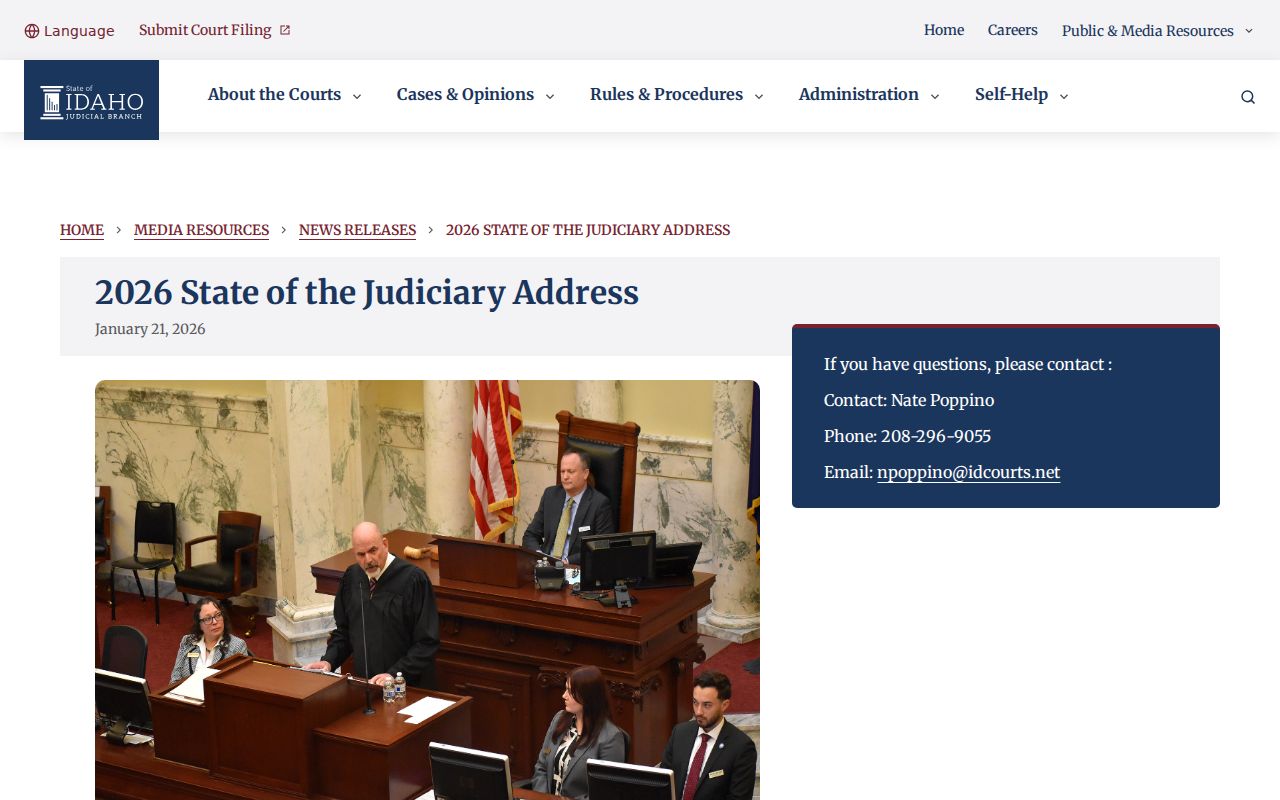
The figures show a centrally supported judiciary that still relies on counties for local facilities, clerks, and file access.
Note: Statewide iCourt status does not guarantee that a historical document image is available online; the original county remains the retrieval source.
Find Idaho Trial Court Records
District Court and Magistrate Division files are maintained by the Clerk of the District Court in the county of filing. Search statewide case status first, then give the local clerk the case number, party names, year, and exact paper needed. The clerk can quote plain or certified copies and address archive retrieval. Browse the full directory of all 44 Idaho counties to reach the correct court records site. Appellate records already lodged with the Idaho Supreme Court or Court of Appeals follow the separate appellate-record request route.