
Search Idaho Court Records
The Idaho iCourt Portal indexes trial cases from all 44 counties. Smart Search accepts a case number or a party or business name. Search Hearings uses a date range and court location. Public results can show the caption, filing date, status, parties, register of actions, hearings, charges, dispositions, and financial entries. The portal is an index and status service. It does not promise anonymous access to every filed document. Certified judgments, pleadings, exhibits, recordings, and archived papers come from the Clerk of the District Court in the county of filing.
Start with the exact case number when known. A full legal name, prior name, likely county, case type, and filing range help separate similar names. If no result appears, widen the date range, test another spelling, and check the filing county. A sealed case or restricted event may be absent. Older records may never have been digitized.
- Open Smart Search in the statewide iCourt Portal.
- Enter the exact case number, or search a party or business name.
- Use location, case type, party type, filing date, and status filters.
- Open the result and note its county, case number, events, and disposition.
- Ask the filing county clerk for the specific document or certified copy.
The current portal interface displays the statewide coverage notice and public search choices.
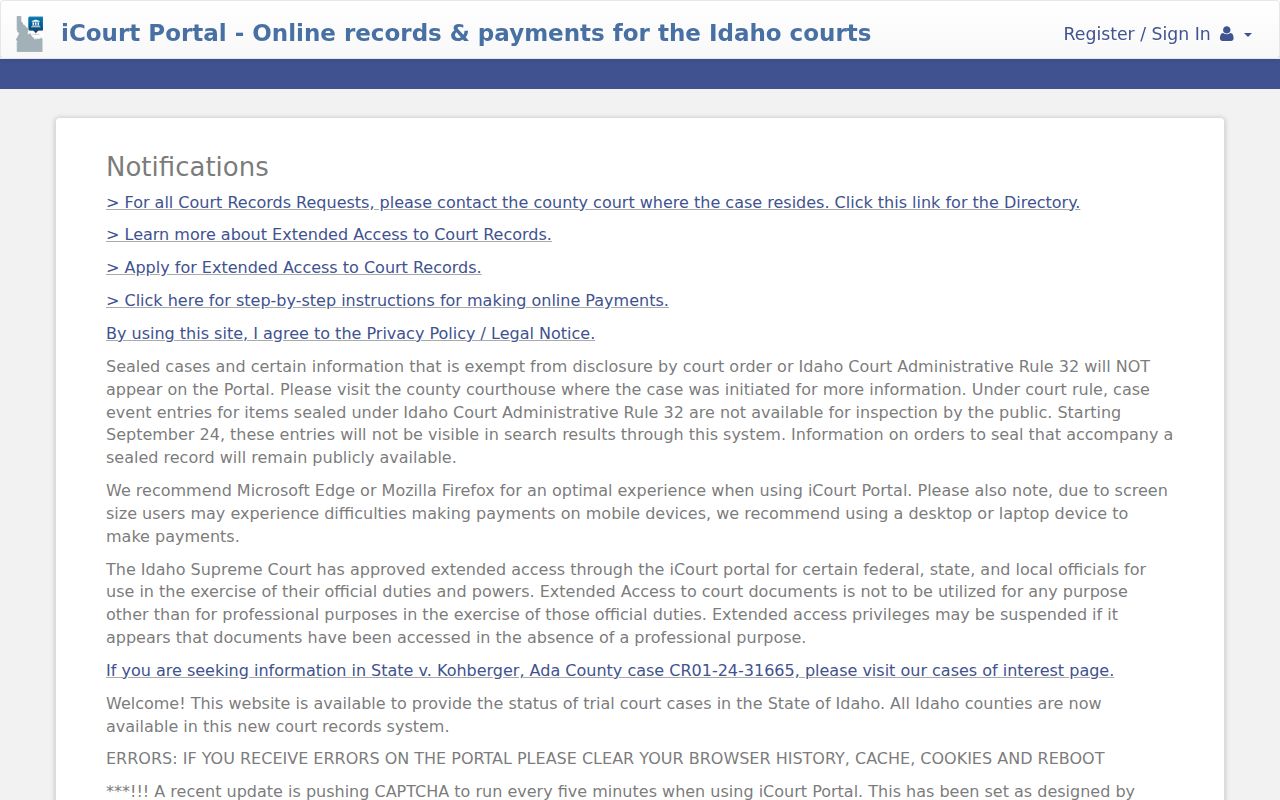
Its CAPTCHA and session controls can interrupt long searches, so save the case number before moving to the county clerk.
| Search Field | Type | Purpose |
|---|---|---|
| Search Criteria | Text | Required case number or party/business name |
| Location | Dropdown | Select the filing county or court |
| Case Type | Dropdown | Narrow the category of case |
| File Date | Date range | Limit results by filing period |
| Case Status | Dropdown | Separate active and disposed matters |
The official iCourt information service also routes users to File & Serve and explains access levels.
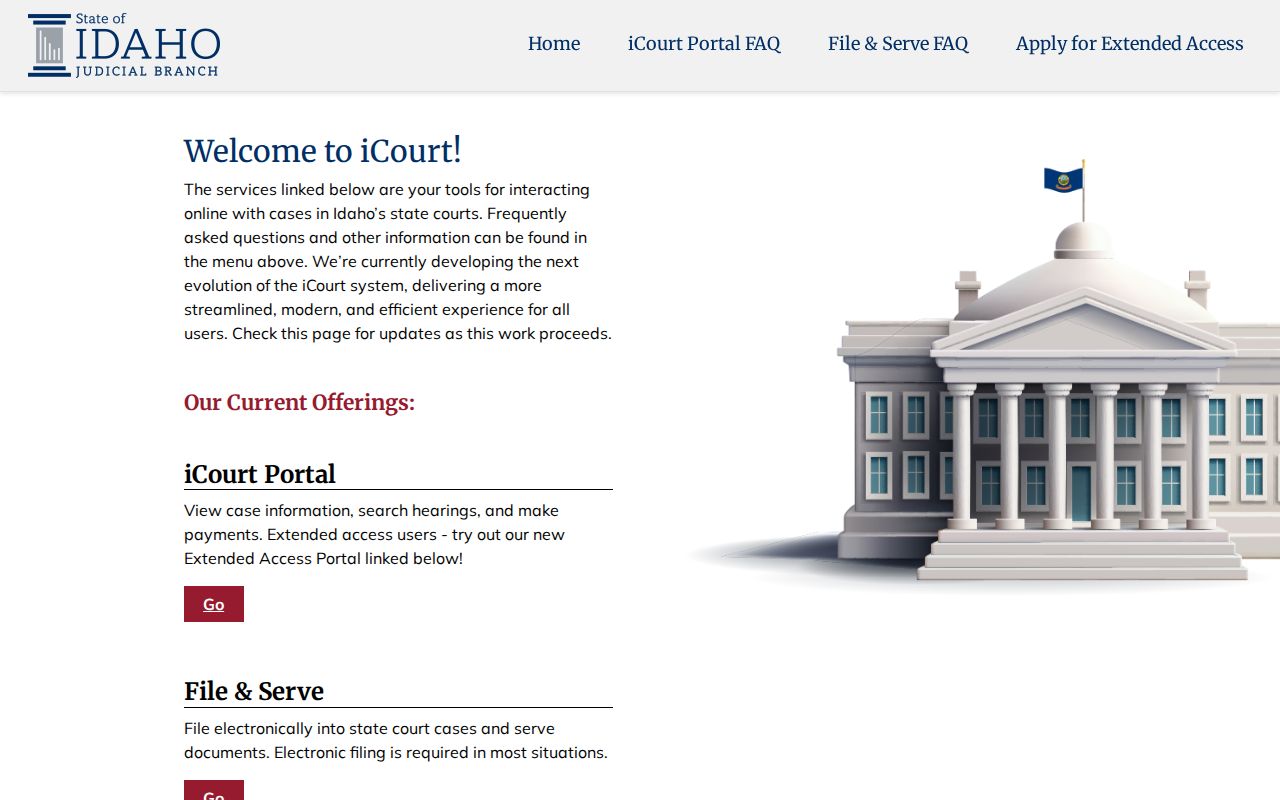
Electronic filing is a submission channel, not proof that a confidential filing becomes public.
The Idaho Court System
Idaho has a unified judiciary with local delivery. The Idaho Supreme Court is the court of last resort and administrative head. The Idaho Court of Appeals is one statewide four-judge court, not a set of geographic districts. It hears cases assigned by the Supreme Court. General trial jurisdiction belongs to District Courts across seven judicial districts. Every county also has a Magistrate Division within its District Court.
Magistrates hear misdemeanors, traffic cases, felony first appearances and preliminary hearings, civil claims through $10,000, evictions, small claims, family cases, juvenile matters, probate, guardianships, and conservatorships. District judges conduct felony trials, hear larger civil claims and agency review, and review magistrate appeals. The full Idaho court system page maps each level and district.
Case flow: Magistrate Division › District Court › Idaho Supreme Court › assigned Court of Appeals review or final Supreme Court review.
| Court | Jurisdiction | Case Types |
|---|---|---|
| Idaho Supreme Court | Final state court and administrator | Final appeals, writs, rules, agency appeals |
| Idaho Court of Appeals | Assigned statewide appellate review | Civil and criminal legal-error review |
| District Court | General trial jurisdiction | Felonies, larger civil claims, magistrate appeals |
| Magistrate Division | Local limited jurisdiction | Traffic, misdemeanors, family, probate, small claims |
The Judicial Branch's official court overview illustrates this hierarchy.
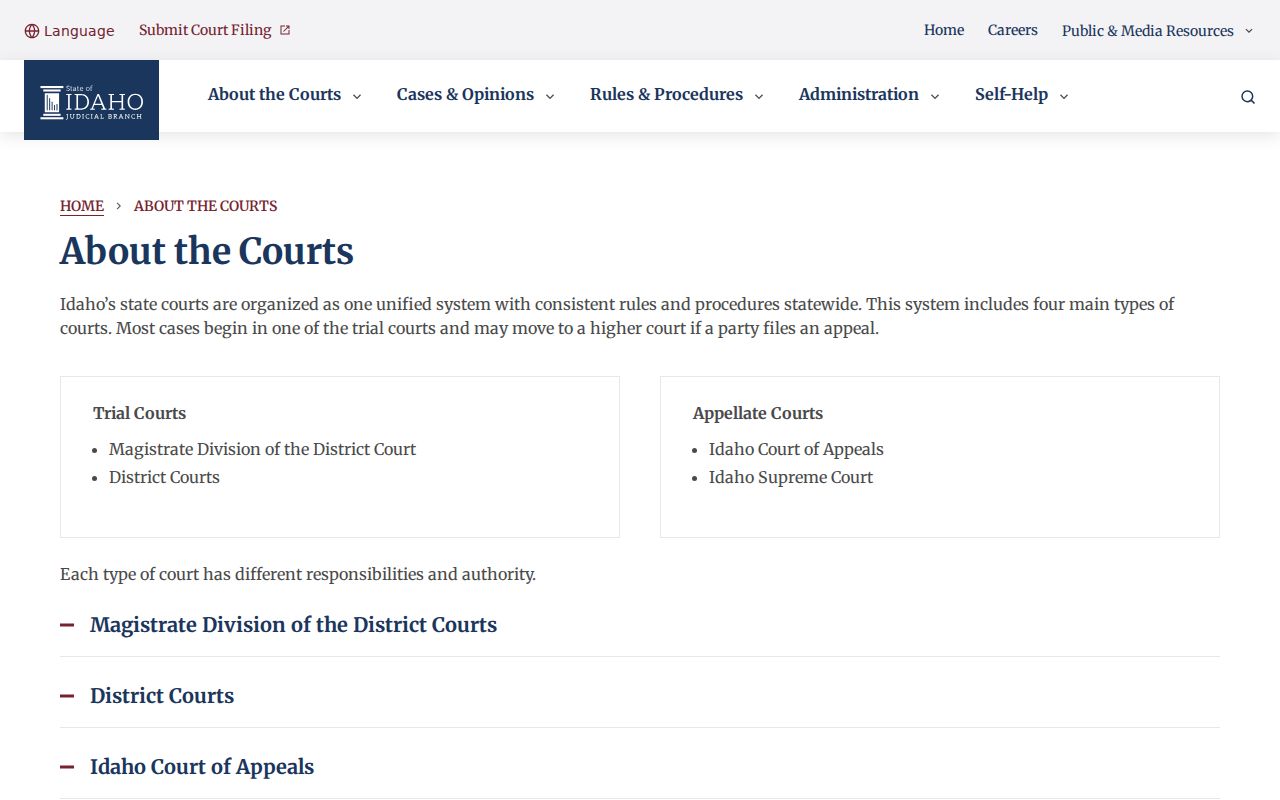
It confirms that the Magistrate Division is part of District Court, not a separate municipal or county court system.
Types of Idaho Court Records
One county clerk office maintains both District Court and Magistrate Division files, though separate counters may handle different work. Civil files hold complaints, service returns, answers, motions, orders, judgments, and exhibits. Criminal files trace charges through plea or trial, disposition, and sentence. Family files cover divorce, custody, support, and protection matters. Access can vary within each file when reports or identifiers are protected.
- Criminal records: complaints or informations, pleas, hearings, rulings, disposition, and sentence.
- Civil records: claims, service, responses, motions, evidence, judgment, and enforcement entries.
- Family and divorce records: petitions, disclosures, parenting issues, decrees, and later orders.
- Probate records: estate petitions, wills when filed, notices, appointments, inventories, and orders.
- Traffic records: citations, pleas, findings, fines, and payments, distinct from a DMV driver record.
The Idaho Judicial Branch homepage provides official routes to cases, payments, forms, rules, and opinions.
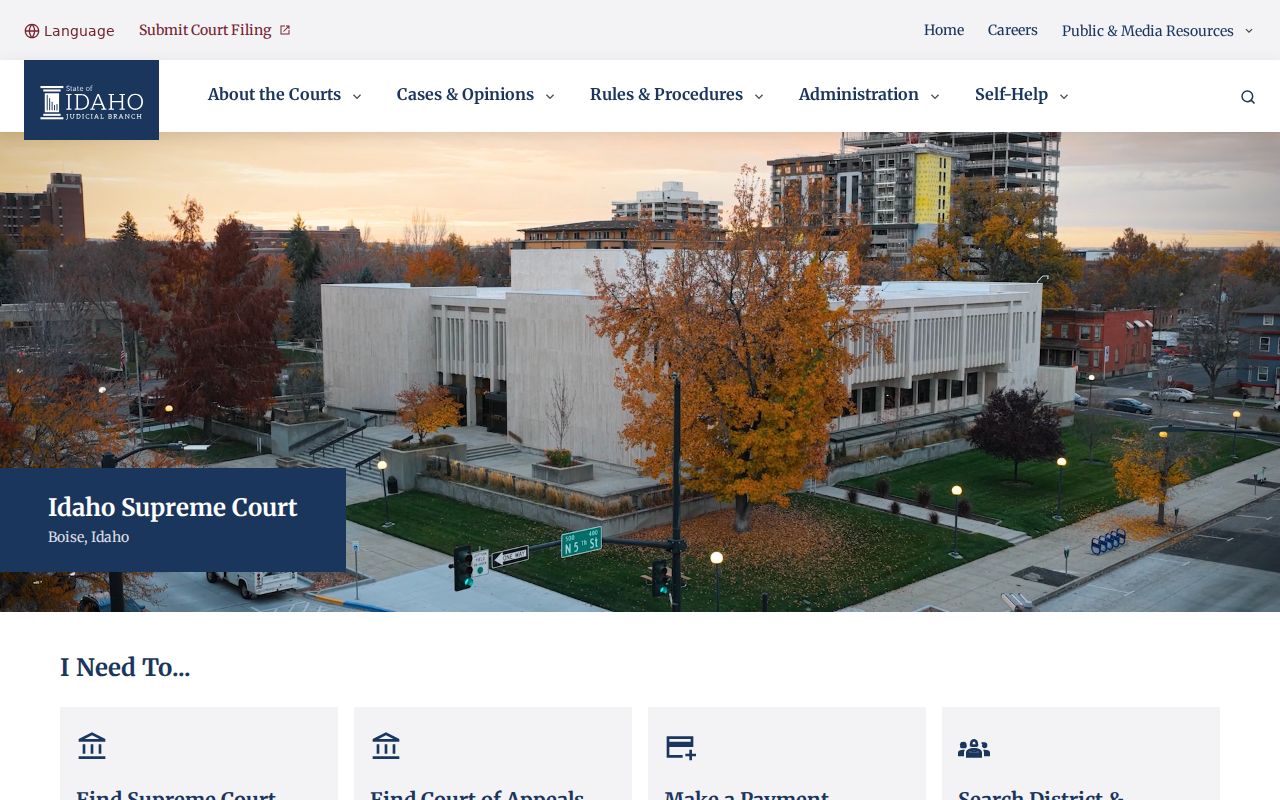
Those statewide routes complement local clerks rather than replacing the county-held source file.
What Idaho Court Records Show
A public result begins with identity and status. The case number ties later requests to the correct file. The caption identifies parties and roles. The court location and filing date show where and when the action began. A register of actions lists filings, notices, hearings, minute entries, orders, judgment, sentence, and appeal activity. Criminal results may show each charge, statute, class, plea, disposition, and date. Financial fields can include assessments, payments, balances, and restitution information when public.
| Field | What It Shows |
|---|---|
| Case Number | Unique court identifier and best search key |
| Filing Date | Date the clerk opened the action |
| Parties | Names and roles such as plaintiff, defendant, petitioner, or respondent |
| Charges / Cause | Filed allegations, statutory counts, or civil case category |
| Disposition | Outcome of each count, claim, or case |
| Sentence / Judgment | Final relief, penalty, financial order, or court ruling |
A charge is an allegation, not a conviction. Dismissal, acquittal, amendment, and a guilty finding have different meanings. Read each count's final disposition and later orders instead of treating the first filed charge as the outcome.
Idaho Statewide Record Systems
Court files are only one part of a records search. The Idaho Department of Correction tracks people in state prison and under Idaho probation or parole. County sheriffs keep local jail bookings. Idaho State Police's Bureau of Criminal Identification compiles Idaho criminal history submitted by justice agencies. The Transportation Department maintains driver-license records, while the Bureau of Vital Records and Health Statistics issues statewide marriage and divorce certificates. These systems answer different questions and should not be substituted for the county case file.
Use Idaho inmate records to separate county jail and state custody searches. Idaho warrant records require local court and law-enforcement checks because no public statewide warrant database was found.
| System | What It Holds | Run By |
|---|---|---|
| Resident/Client Search | State prison, probation, parole, discharged names | Idaho Department of Correction |
| Idaho Central Repository | Compiled Idaho criminal history | Idaho State Police BCI |
| Driver License Record | License status and driving history | Idaho Transportation Department |
| Marriage/divorce certificates | State certificate data, not full case files | Idaho Vital Records |
The Idaho court data portal serves a different purpose by publishing court operations and statistics.
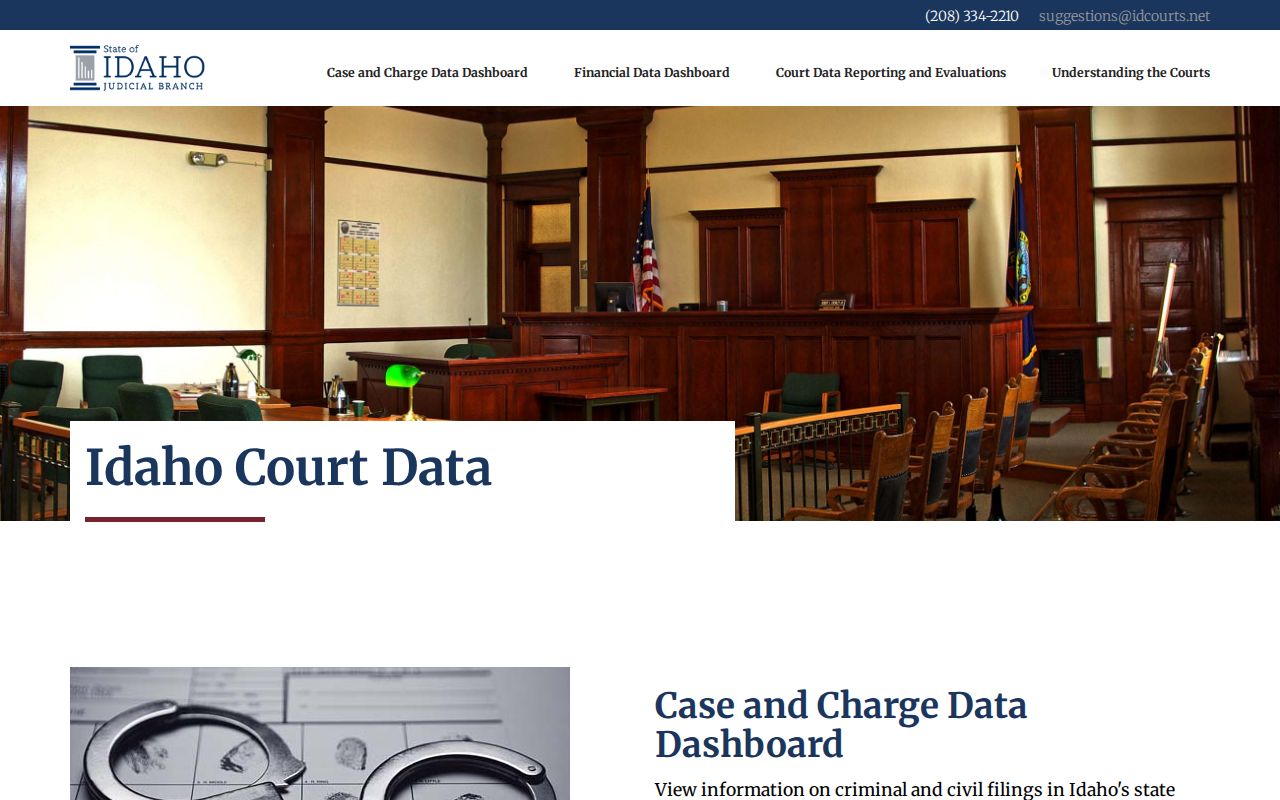
Aggregate data cannot certify what happened in an individual Idaho court case.
Idaho Court Records Access Law
Idaho Court Administrative Rule 32 is the central authority for judicial records. It presumes access to open proceedings and defines which indexes, calendars, filings, orders, judgments, recordings, and admitted evidence are public. It also controls local and online access, redaction, sealing, custodian review, and copying costs. For most judicial requests, the custodian has three working days to disclose, deny, or refer the question to a custodian judge. When more time is needed, notice is given and the outside response period is ten working days.
Title 74 governs records held by executive agencies such as IDOC, DMV, BCI, and sheriffs. It does not turn the Attorney General into the custodian of county court files. Direct a trial-file request to the filing county. Direct agency records to that agency's custodian.
Key authorities:
ICAR 32 governs judicial access, restrictions, sealing, and copy costs.
Idaho Code §§ 74-102 and 74-103, reproduced in the Attorney General's manual, govern general agency inspection and response.
Idaho Code § 67-3004(11), implemented through Rule 32, provides qualifying criminal-case shielding.
The official Idaho Court Administrative Rules page carries the current Rule 32 text.
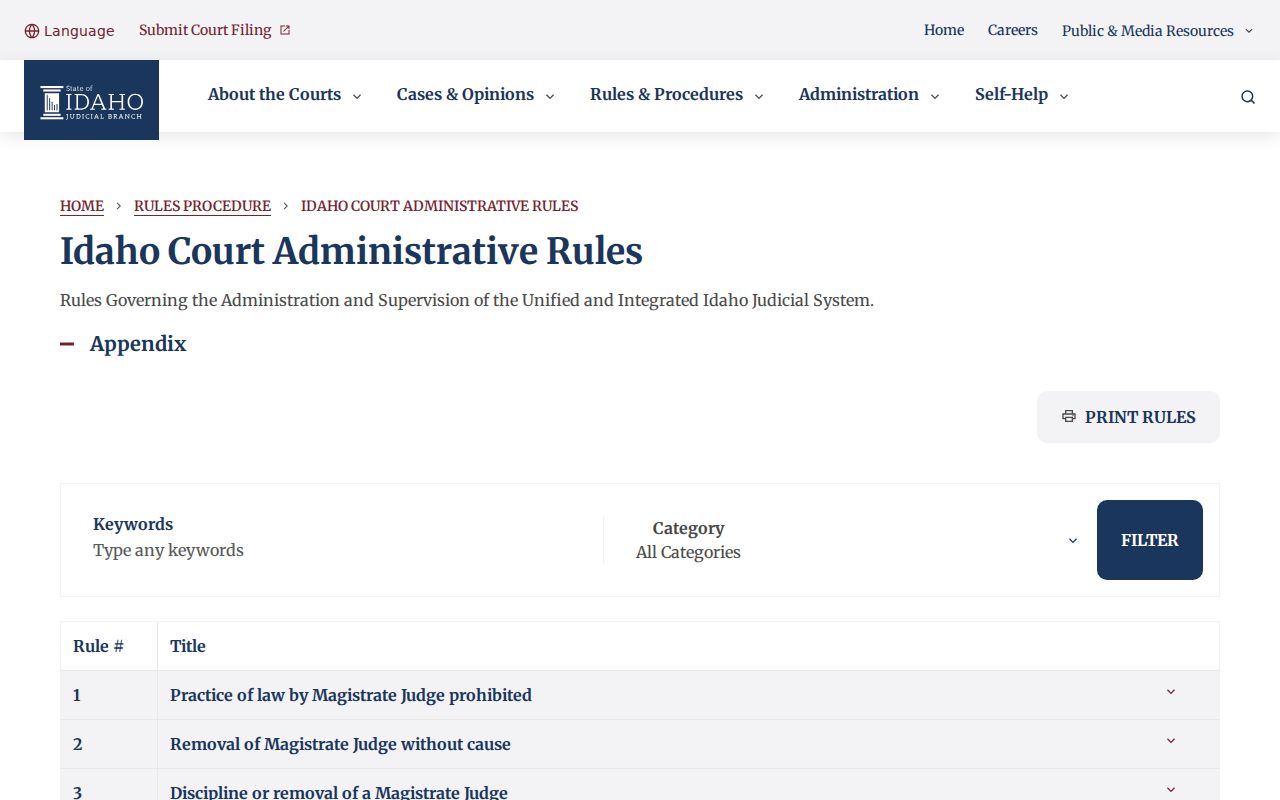
Use the live rule because sealed-event visibility and access provisions change over time.
Restricted Idaho Court Records
Juvenile, adoption, mental-health, and protected treatment records are not ordinary public files. Rule 32 also protects unredacted Social Security numbers, complete financial accounts, driver-license numbers, protected addresses, certain minor identities, presentence reports, pretrial risk assessments, confidential informant material, and unreturned search warrants. Exhibit access can require a custodian judge's permission before final disposition.
Idaho distinguishes redaction, sealing, exemption, and shielding. Redaction hides protected data while leaving the balance open. A sealing order restricts access after judicial review. Exempt material is closed by rule or statute. Qualifying criminal-case shielding removes the case from public disclosure but preserves access for the defendant and official justice users. Relief is sought in the county court that controls the case. A portal change does not automatically alter sheriff, prosecutor, federal, news, or privately retained copies.
Find Idaho Records by County
The statewide index helps locate a case, but the elected county clerk serves as Clerk of the District Court and certifies the local file. Idaho's six largest counties span six trial districts and include the state's busiest metro court systems. Each card opens its dedicated county records site.
Ada County
Boise · Largest Idaho court and records workload
Canyon County
Caldwell · Third District metro services
Kootenai County
Coeur d'Alene · First District regional center
Bonneville County
Idaho Falls · Seventh District regional center
Bannock County
Pocatello · Sixth District and federal court location
Twin Falls County
Twin Falls · Fifth District and early iCourt pilot
Browse the full directory of all 44 Idaho counties to open the court records site for any county.
Idaho Court Records Fees
Rule 32 lets the clerk set paper-copy cost up to the maximum in Idaho Code § 31-3201, and prepayment may be required. Research did not establish one reliable price for every county, certified copy, exhibit, transcript, or recording. Ask the filing clerk for a quote and state whether the request is for inspection, a plain copy, a certified copy, an exemplified copy, a transcript, or audio. Filing fees and agency-record prices are separate products.
| Item | Amount |
|---|---|
| Court case paper copy | Clerk-set within statutory maximum |
| Certified court copy | Confirm with filing county |
| BCI name-based history | $20 per subject |
| ITD driver record | $7; certified record $21 total |
Interpret Idaho Court Records
A docket is a chronological index, not the whole file. A complaint or petition starts a matter. A motion asks the court to act. An order records a judicial direction. A judgment resolves a claim, while disposition states the outcome of a case or count. In criminal cases, read the original charge, amendments, plea, disposition, sentence, and later appeal or shielding orders together. A hearing entry can be reset or vacated, so verify the current calendar before traveling.
Idaho Courts and Technology
Idaho's Supreme Court and District Court framework dates to statehood. The Court of Appeals was created in 1980 and began hearing assigned cases in 1982. Magistrate reform gathered traffic, misdemeanor, family, juvenile, probate, eviction, and small-claims work into a division of District Court. Later, statewide iCourt technology connected all counties while preserving local custody of original and certified trial documents.
The Judicial Branch annual report documents caseload, staffing, treatment courts, and statewide operations.
For FY2025, the judiciary reported 154 trial judges and nearly 58,500 prosecutor-presented criminal cases across Idaho.
Modernization also created distinct public, attorney-of-record, and approved extended-access paths. The court technology report describes the attorney portal, public improvements, and cybersecurity work.
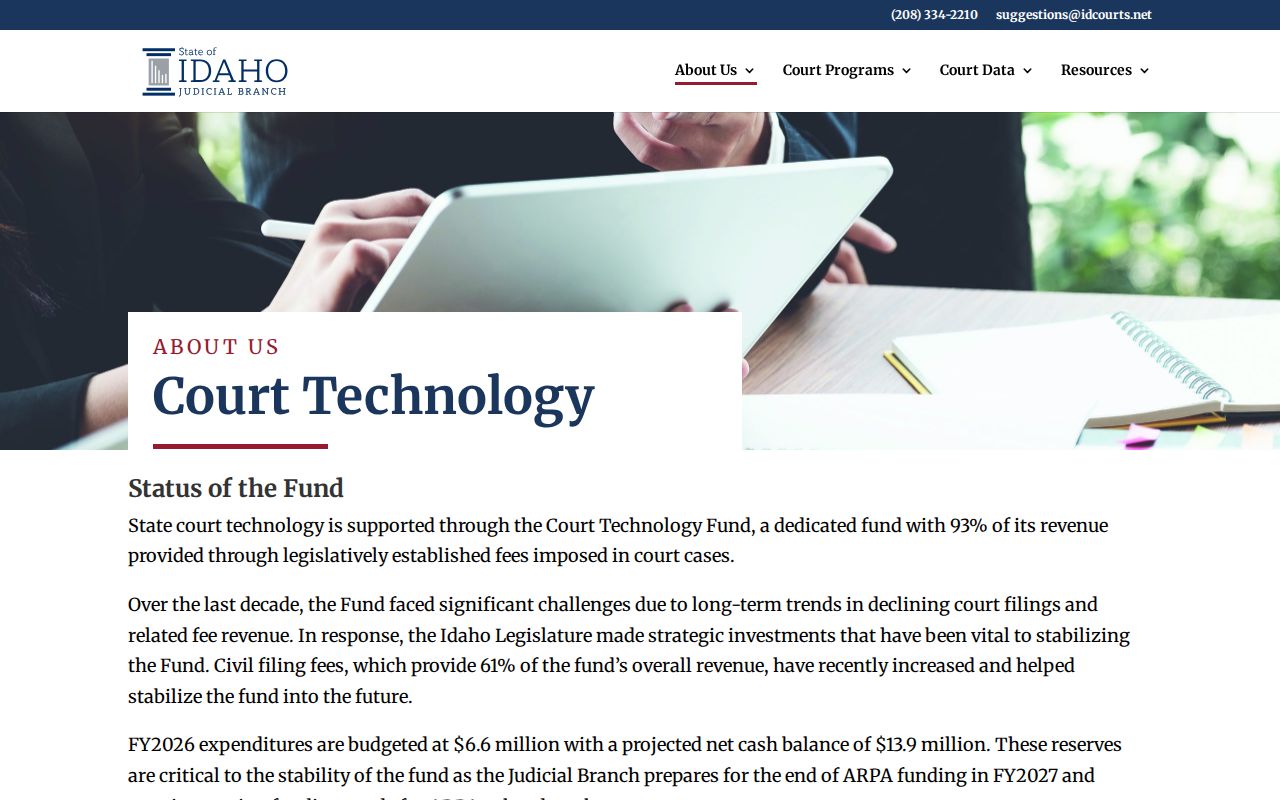
Tiered access means an electronic document can be available to counsel without becoming an anonymous public download.
Verify Idaho Court Records
Online entries can lag, names can match more than one person, and a listed filing does not prove its allegation. Confirm identity through several fields. Then read the final disposition and later orders. The county clerk can explain how to request the source document but cannot give legal advice. To correct an error, first identify whether it sits in the court file, BCI history, jail system, driver record, or private database because each has a different custodian.
The Judicial Branch's official records route distinguishes iCourt case information, county-clerk documents, appellate records, and administrative or compiled data.
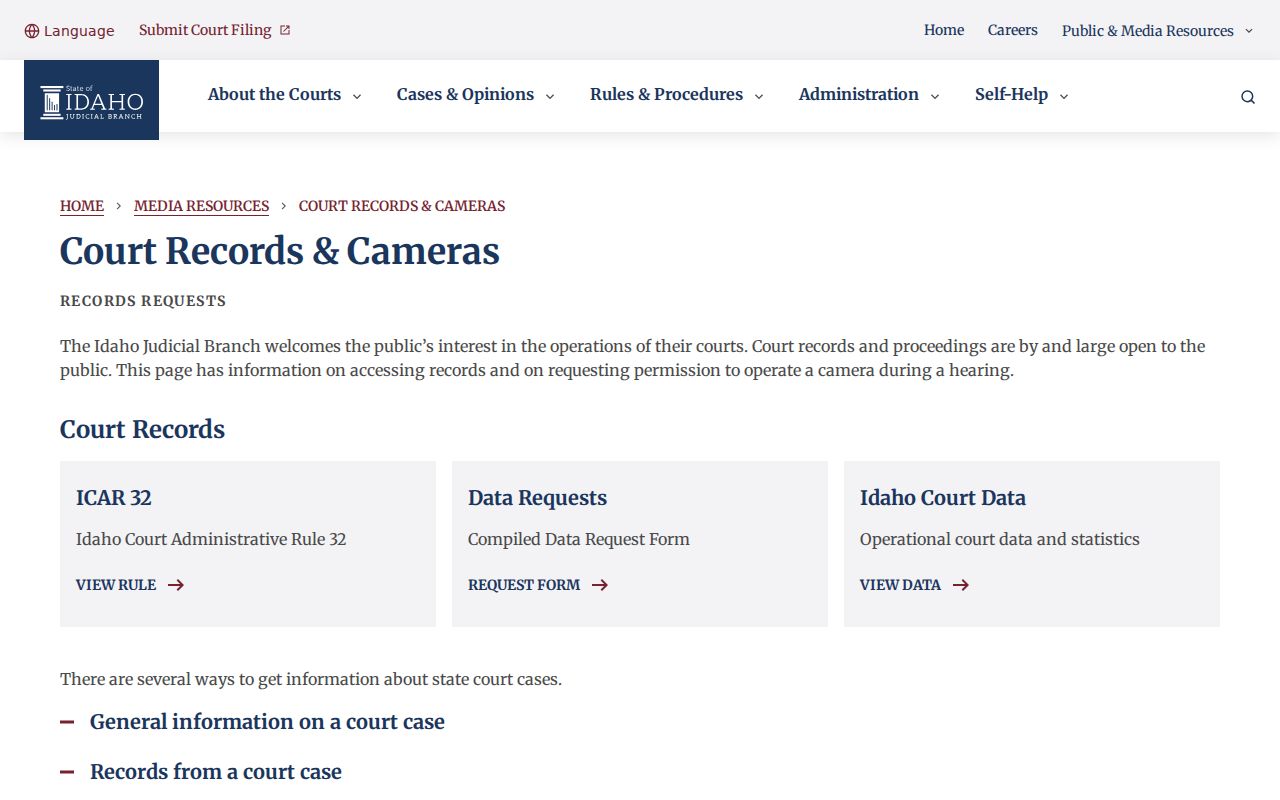
Use that custody map before sending a request so it reaches the office that can answer it.
Note: Confirm any result with the filing county clerk before relying on it as a complete or certified Idaho court record.
Idaho Court Records Questions
Are all Idaho documents online? No. iCourt provides statewide status and public event details, but anonymous document access is limited. Ask the county clerk for pleadings, certified orders, exhibits, audio, or archived material.
Which clerk keeps the file? The elected county clerk serves ex officio as Clerk of the District Court. The filing county holds District Court and Magistrate Division trial files. State appellate records follow a separate request route.
Why does a case not appear? Check spelling, prior names, county, date range, and status. The matter may be old, sealed, shielded, exempt, or filed under another name. The county clerk can check legacy records.
Does Idaho have municipal courts? No separate municipal or justice-of-the-peace court system must be searched. Local traffic, ordinance, misdemeanor, and similar work is handled through the Magistrate Division.
Is a case search a criminal history? No. A court search follows a filed case. BCI compiles Idaho criminal history from justice agencies under separate rules.
Can a result be used for employment screening? This private reference site is not a consumer reporting agency. Employment, housing, credit, insurance, and other regulated uses require lawful FCRA-compliant processes.